Showing posts with label reviews. Show all posts

Sunday, 31 May 2026

Beyond the Arabian Nights: an exhibition at the Louvre-Lens


A copy of Delacroix, Femmes d'Alger, 1867, by Henri Fantin-Latour

I should have got the message from the title of the exhibition, the impression I got was that it would have major works from the Louvre’s world-class collection of Islamic art.

For the first time ever, a remarkable group of pieces from the Department of Islamic Arts at the Louvre Museum will be displayed at the Louvre-Lens. Among them are two exceptional masterpieces: the Baptistery of Saint Louis and the Lion of Monzon. This unprecedented loan is complemented by artworks from French and Belgian collections.

I like the way the Louvre is thanked for its “unprecedented loan” to the Louvre-Lens, in other words, to itself. However, Islamic art was outnumbered in this show by French works. The exhibition focused on European (mainly French) responses to Islam, or imaginations of Islam. This kind of exhibition (which we can call Orientalism, although the term has been extensively criticized for its ambiguity) is now quite a commonplace for art exhibitions. Said’s book, Orientalism, dates from 1978, and there were exhibitions at the Royal Academy in 1984, The Metropolitan in 2004, and many others. I was astonished to discover the Metropolitan was lining up a new Orientalism exhibition from June 2026.

Isn’t it somewhat colonial to continue to focus on Western artists and their response to Islamic art, rather than look at the Islamic works themselves? What I saw was a number of exhibits that by current standards would never be shown in public, for their sexism and racism. The Louvre has a major collection of Islamic art (in fact, there is a catalogue of the Louvre Islamic collection available to view in this exhibition, although it is not on sale in the Louvre-Lens bookshop), comprising over 14,000 objects, displayed in Paris with a dedicated Islamic gallery only opened in 2012. It wouldn’t be difficult to have an exhibition of some of these pieces in Lens, and to have an exhibition of Islamic art per se. Instead, this show gives the impression not just of tolerating old attitudes, but even encouraging, condoning, or even paradoxically celebrating them. Why are we being shown stereotypical attitudes that are today widely condemned, via artworks of little quaility? For example, you can be pretty sure that any commercial film adaptation of The Arabian Nights dating from the 1960s or earlier would have primitive attitudes, and the clips seem to confirm it. Was it really necessary to include them? Are these among the 300 “masterpieces” on show at this exhibition? This show looks, for the most part as if the curators looked in the dusty archives to see what wasn’t being shown, but was easy to use. Even when you think a major work has been included – there are works by Matisse and by Delacroix – you then discover that the version on show of Delacroix’s Femmes d'Alger dans leur appartement is a copy, rather than the original. Other works, such as a bronze Napoleon riding a horse, seem to have little relevance to the show’s theme.

Instead, we had displays of what the museum already holds – lots of Orientalist works from the last 150 years, much of it displayed out of context. For example, there were the remains of a Paris collector’s apartment, with Islamic objects – but the like so much else in the exibition, these objects were included because a French collector had purchased them. Imagine a show in Saudi Arabia of French art that only included pieces bought by Arab collectors; it would not be a very comprehensive display.

The exhibition closed with some contemporary works, which were supposed to illustrate some kind of progress in orientalist attitudes, but I’m afraid to say in some cases they perpetuated the stereotypes. There was a video of a woman writing on her bare belly, explaining that she was in so doing removing the objectification of women in so much European art. Since her head was never visible, I didn’t feel I a position to see the video in a non-objective way.

There were indeed two major Islamic works, Baptistery of Saint Louis and the Lion of Monzon, but the first is well-known because of its use for baptising French kings. I would have like to come away from the exhibition knowing more about Islamic art, not more about what 19th-century French artists and collectors thought about it. To quote from the exhibition blurb: 

Orientalisms are historical and imaginary accounts. Like any account, they can be transmitted, rewritten, expanded, questioned and criticised. Like any account, they contain both light and dark elements. Like any account, the rest of their history remains to be written, which is expressed by the views of contemporary artists whose artworks are present throughout the exhibition.

Personally, I would stop calling it “orientalisms”, and I would focus on “Islamic art”. It doesn’t seem so radical.

Friday, 22 May 2026

What Robin Lane Fox thinks about The Bible: The Unauthorized Version


I wrote about this book while I was immersed in it, and now I have completed it, I can give perhaps are more rounded impression.

Books and websites about the truth or otherwise of the Bible are so prolific, that you would think some ground rules would have been established. Nonetheless, I have only praise for Lane Fox for writing the book, as I initially welcomed the idea of reading what a readable but authoritative historical scholar thought about the Bible. I was brought up in a Christian environment (largely from my school, but also from the wider world) where the Bible was taken, well, as gospel. So the realisation that Biblical scholars have been reassigning and critiquing Bible texts for more than a hundred years was a remarkable discovery. Although this book is largely a distillation of others’ research, it is welcome for all that, since it provides a very clear vision of two opposed worlds: the biblical scholars, who assume authors such as “D” or “P” to explain discrepancies in vocabulary, subject-matter, and chronology, contrasted with the world of believers. The Web is full of writers who will artfully explain to you why the Bible is right, even though the scholars have just proved it wrong. One of the things missing from Lane Fox’s book is just this contrast. There could be a hundred books like this one, without it making any difference to the world beyond the academy. Should this not be considered? In the domain of science, no doubt many people still believe the sun rotates about the Earth,  but it doesn’t make a huge difference, as their knowledge is a kind of cul-de-sac. In contrast, belief in religious systems causes deaths on a vast scale, and (to give just one example) is coupled with the dominant political ideology in the United States and fills me with dread (such as recent calls by right-wing Christians for women to lose the vote and to remain in the home). Academic knowledge, in this domain, is strangely impotent, and you would think that Lane Fox would consider the impact of his writing. Voltaire, in contrast, gleefully grabbed the headlines with his anti-clericalism and dissemination of inconsistencies in the Bible (in his Philosophical Dictionary and elsewhere). The world has need of a  Voltaire today.

Is Lane Fox a believer?

One reviewer summed it up nicely as “Fox doesn’t believe in God, but he does believe in the Bible”. Make what sense of this you can. You would think it a rhetorical question when the author announces as early as the Preface “I write as an atheist”. Yet his fondness for some of the books, such as the Gospel of John, is very visible (he keeps referring to its author as “the beloved disciple”

To summarize the book, it is a broad overview of Biblical textual scholarship, covering the Jewish Bible, the Christian New Testament, and some of the other early Christian writings. This would make it just a secondary review of literature, and to a large extent, it is, but Lane Fox attempts to provide his own angle in two ways. First, he writes as a historian, and claims to assess the Bible as history. I’ll discuss that one below. Second, and much weaker, he has his own views on the many Biblical scholars he refers to – but as a reader, I’m so overwhelmed with the details he is reporting that his own views are of minor interest.

His claim to evaluate the Bible as history is at odds with his practice. He seems quite relaxed about the telling of miracles in both Jewish Bible and the New Testament. Voltaire, in contrast, has a clear point of view, and enjoys himself immensely revealing the inconsistencies of Christians, who maintain that every miracle carried out by Christ and the Apostles in the New Testament is infallibly true, yet reports of more recent miracles in the present day are treated with great doubt. Well, Mr Lane Fox, where do you stand? Do you believe some of the miracles but not others? As a historian of the ancient world, Lane Fox has the example of Herodotus to compare. I’m no Herodotus scholar, but apparently Herodotus also had this kind of on-off view of miracles: he believed in the Delphic Oracle, but not in some other miraculous events he reported. Nonetheless, Herodotus was prepared to believe in the intervention of the Gods. Whatever the case, I would expect Lane Fox to compare the treatment of miracles in non-Biblical sources with Bible accounts. You could explain them, perhaps, as part of the ancient world view, just as views of women, justice and revenge were fundamentally different at that time. But that isn’t made sufficiently clear; I don’t think the author ever clearly states his view on the major Christian miracles (the resurrection, the Virgin birth, and so on). 

What Lane Fox reveals

Nonetheless, the book has some startling revelations. Among the discoveries reported by Lane Fox (he wasn’t the first to find them, but they are nowhere nearly as evident as they should be) are:

  1. The Christian Bible does not move from retribution to forgiveness (as we are taught at school). The Book of Revelation ends with “the slaughter of most of humanity”. “There is no comforting progression, from a barbarous God of war to a later and milder God of love”
  2. The Nativity is a fabrication. Jesus was not born in Bethlehem, and the wise men were added later.
  3. Many of the links between the OT and the NT were added by later editors.
  4. The Bible is not the word of God (one of the most often repeated claims). Its textual history is messy and highly contested. Many books of the Bible appear to be by multiple authors, written at different times and shoe-horned together. Even the accounts of Jesus in the New Testament are reported in the four gospels with discrepancies between them. Specifically, quotes attributed to Christ are written in four different styles, depending on the author – and the style is continued in the author’s text, so, in essence, you are presented with four different Christs. 

A poor piece of publishing

It’s partly the author’s fault, and partly the publisher’s:

  • Poor index: there are over 400 pages of closely-argued text, but the inadequate index covers mainly proper names. A digital version with every word indexed would be a great help.
  • As an academic, the author hides behind the use of “we” and quotations that are not cited in the text. This gives the impression of a committee of authority that knows the truth, which we, the readers, are privileged to share (but not to alter).
  • Lane Fox’s peculiar system for citations is weird. Quotations are cited, but not in a clear way. He chooses, for reasons best known to himself, not to assign an author to most of his quotes in the main text, and only to refer to these authors in an elliptical way. At several places I have wasted time trying to work out who he is quoting.
  • He assumes far too much knowledge on the part of the reader. He expects a grasp of Middle Eastern ancient history, early Jewish history, early Christian history, and good knowledge of the Bible text, including the Apocrypha. He provides no chronology, no list of Bible books, and maddening chapter titles that do not describe what is contained in them.
  • Perhaps the book would be better organized as a thematic companion to the books of the Bible
  • The author thinks he is witty, and includes many cryptic allusions, which you might (or might not) recognize. Either way, it doesn’t help the intelligibility of the text.
  • His concepts of “historian” and primary sources aren’t very helpful. I’ve written about the former in an earlier post. He confidently distinguishes books that are more valuable because they have “primary information”, such as the books of Kings, but to be honest, I think this misses the point. If presented as a work of faith, we judge it differently to a work of history. We remember the Book of Job, which doesn’t have the slightest historical truth, rather than the Book of Kings, however accurate it may be. 

The Unauthorized Version is just one of many books by scholars attempting to clarify their view on the veracity, and historical position of the Christian (and Jewish) Bible. Below the surface, it seems to me that the author is struggling with some kind of belief that he cannot somehow reconcile with his academic career. Four hundred pages later, he is no more comfortable, it would seem, than when he started. The Bible is full of errors, he seems to say, and yet, four hundred pages later ... 


Saturday, 28 March 2026

Is the Bible true? Measuring religious texts against criteria of truth and accuracy


A page from one of the Dead Sea Scrolls, one of the sources discussed in The Unauthorized Version [Public Domain]

I used to recommend that all theology departments in universities should be closed down, since their very title “department of theology” suggested to me at the time that they were at odds with the disinterested search for the truth that is the essence of the enlightenment institution. This was the result of reading a lot of Voltaire, I must admit. He used to sit at home of an evening, with his partner Madame du Chatelet, having great anti-clerical fun in discovering inconsistencies and impossibilities in Bible texts

Reading Robin Lane Fox’s The Unauthorized Version: Truth and Fiction in the Bible (1991) has changed my view somewhat. It makes me realise that much of the output of theological departments is valuable, in that it demonstrates the impossibility of any kind of belief in the “truth” of scripture. Within a few pages, Fox reveals a very different view held as a consensus by biblical scholars about the Bible: for example, that the Gospels were mainly not written by the person whose name is attached to them. In the Old Testament, anonymous (and often multiple) authors are the norm. So not  only is there a “Q”, a supposed source for the New Testament narratives, there are also sources J, E, P and D for some of the most familiar Old Testament books such as Genesis.

So this I can understand. University departments of Literary Studies are used to trying to establish an accurate text, and in some cases, this is simply not possible. Lane Fox has tried to apply the skills he has learned from working in a classics department to determine the truth or otherwise of Biblical books, regarded simply as another classical-period text.

The result is fascinating, even if more difficult to read than it should have been (see below). Basically, Lane Fox tries to determine if Biblical books make use of primary sources (they do not), and if they can be regarded as proper history (they cannot, for the most part). This is where his argument becomes interesting, because he applies, I think, rather simplistic criteria to assess his texts. Here, the index fails completely: it is only an index of proper names, so there is no index term “primary”. So I have to hunt for myself, using the digital version in The Internet Archive, to find Lane Fox’s discussion about what constitutes history. There is a very relevant passage in Chapter 11, “Ideas of History”. Lane Fox describes the distinction between primary and secondary sources, that we are all familiar with from school, and claims to use this as one criterion for evaluating Bible texts:

For the question of historical truth, the line between primary witness and secondary source or tradition is more fundamental than the line between oral and written. In the Hebrew Old Testament it is clear that no book is primary in this strong sense. [p173, Penguin edition]

While I am fascinated by Lane Fox’s careful survey of a mountain of over a hundred years of Biblical scholarship, I think his idea of what constitutes history is somewhat simplistic. Probably 99 per cent of all historical writing is not based on primary sources, and this book is a typical example. I don’t expect Lane Fox to have read all, or even any, of the primary sources he is discussing; it would take a lifetime. Instead, I am grateful that he has summarised what many scholars, no doubt based in university departments of theology, have done: to review, line by line, the original texts, and to determine their authenticity, the theological equivalent of the Arden edition of Shakespeare. We read the Arden edition because it is the considered thought of a scholar much more knowledgeable than us, and with more time than we have, to reach a conclusion. When we read, we use a variety of means to assess how far we can trust the scholars, and then we make our own judgement -- and at various points in the narrative Lane Fox is very emphatic to state his own view of the evidence, for example, on page 85, “The mission of Ezra … involves the law more historically; in my view, it is historical and belongs to 398 BC (others opt for 458).” In writing this, Lane Fox is telling the reader, trust me, I’ve read this stuff, and I have weighed the evidence for myself.

In departments of literature, scholars may spend several years preparing a critical edition of one text. For the most part, all of us, academics, students, or general readers, we assume the decisions taken by the textual scholar are trustworthy, and we move on to assessments of interpretation of the text. Something of this kind must happen in science, also; a narrative is used as the explanation for what is happening, and for most purposes, we work within the limitations of each model.

So I’m very grateful to Lane Fox for the work he has put in to assemble this view, even though his is a secondary work. Most of my historical reading (and, I guess that of most people) has been of this kind of level. After all, it’s how we operate. We read or listen to the news and we don’t have time to investigate primary sources. If we hear a news clip, we know it has been heavily edited and selected and may not reveal the truth of the story, but we have no choice but to accept it, for the most part, until we find some reason to doubt.

Incidentally, my only complaint about Lane Fox is, paradoxically, his slapdash referencing system. He does not use footnotes, but links to references by using references to the main text. But his use of references is partial (he doesn’t cite all his sources) and uncertain: many direct quotations in the text at not cited properly in the endnotes (e.g. p81 “exemplified by completeness” – which book is this extracted from?), plus, equally annoying, the assumption that the readers know more than they do. For example, the reference to “Samson’s unfortunate foxes” on the same page (p81) made no sense to me, until I looked up the reference and found out what the episode was about. Lane Fox has a rather cavalier attitude to his readers: they don’t know scholarship about the Bible, but they do know (a) the outline of Jewish history, including all the major exiles, and (b) the books of the Bible and everything they contain, even if they don’t know the latest scholarship. Finally, there should be a full list of all books cited or referred to, in alphabetical order. As often happens in books for a wide audience that have scholarly pretensions, Lane Fox assumes in his bibliography you may want a review of the latest year’s articles, when most of his readers are struggling to follow his basic text. Still, I'm grateful that this book exists; it's made me think much more deeply about topics that are taken for granted for so much of our lives. 

Sunday, 22 February 2026

Anna Ancher


Brondum's Dining room, Skagen, 1891

Anna Ancher gets a solo exhibition at the Dulwich Picture Gallery - apparently, her first solo exhibition in the UK. When you visit Skagen, where she was born and lived, you immediately get the impression of a group of artists, living and working together; Anna as one of several contemporaries. Consequently, it was strange to see Anna Ancher in a solo show here, detached from the Skagen artists. Seeing work by the other group members would make it easier to form ideas of how Ancher was (or was not) unique. Her profile portraits, for example, are very much in the group style, as can be seen from the photograph above.

At her best, Ancher captured some lovely effects of light, notably in the best painting in the show, Sunlight in the Blue Room, 1891. 


But it’s difficult to make much of a judgement on the basis of the works exhibited. For me, one of the most impressive works by Ancher was actually a joint painting with her partner Michael: Appraising the Day’s Work, 1883. This painting is in the catalogue, and is held at the Skagen Museum, so why wasn’t it in the show? It seems to demonstrate very clearly the relationship between the two, sharing ideas. This painting surely, answers the question posed by the catalogue, how Anna Ancher was able to be a full-time female artist around 1900? As the catalogue states, “One wonders whether her success would have been possible without the help and support of the male painters in the artist colony, including her husband” [catalogue, p18]. But for this show, you would hardly know her husband, or the other artists in the Skagen group, existed. It seemed very strange to pull just one artist out of this group  - not all of them male – as they painted and exhibited together. Instead, we get four works by women contemporaries – hardly enough to get much of an idea. What about Nordic contemporaries, such as Hanna Hirsch Pauli, who currently has a solo exhibition at the Hirschsprung Gallery in Copenhagen? Did Ancher not see any contemporaries?

As a result, we are left with a small collection, which doesn’t give us enough evidence to make a decision about Ancher. Apart from her ability to capture light, what else is there? A girl in the Garden in summertime 1914 could be a work from any number of provincial collections from the early years of the 20th century. The exhibition raises our hopes about a large number of rough sketches recently discovered, with only two on display, it’s difficult to get any idea of how talented Ancher was in this area. It’s not easy, either, to see much of a progression in the work. There are two paintings of removing feathers from fowl from 1902 and 1904, but the progression between the two seems to have been from a more impressionistic style, with rough brushwork, to a more precise, representational manner; I would have expected the other way round.

The captions were not very helpful. There was a picture of a couple with their rabbits, and the caption stating “perhaps he is waiting to eat the rabbit”. Perhaps he is, but there is nothing in the painting to suggest it. And the quotes highlighted, both in the exhibition and in the catalogue, were not very inspiring: ”Anna Ancher had the courage to stand out … Her many repetitions of similar motifs and her many sketches reveal her persistence and dedication”. The suggestion that in her day landscapes were seen as masculine did not strike me as very convincing. I would have liked more quotes by her, and more context. There may be a story here, but we have to work it out for ourselves, on the basis of rather partial evidence. 


Tuesday, 26 August 2025

Philip Ball: How Life Works


"The real point, as is so often the case with arguments in science (and beyond), is not who is right or wrong but what their positions say about their underlying values and assumptions." 


Philip Ball is a science author and communicator, who is a member of a very rare group: someone who writes with as much authority as the researchers he is writing about. Most popular science writing (this inadequate term is all I have to describe his writing, although it is hardly “popular”) is purely one-way: researchers do what they do, and a science writer (or communicator) writes up in plain language an account of what they do, and tries to put detailed research into some kind of meaningful framework. But Ball wants to go further: not just to describe what some scientists do, not just to create new metaphors, but to contribute to the debate himself. He’s not afraid to state how many scientists were wrong, although that tends to be about dead scientists, and he diplomatically anonymises any negative remarks about what he is doing, such as the researcher who stated his work was dangerously simplifying the situation. 

Ball is also remarkable as a physicist who writes with impressive detail about biology – not many writers can do that. He’s even prepared to tackle topics that most biologists wouldn’t dare approach, it seems: to talk about the nature of life, and even to discuss agency, that highly fashionable world, which is today being applied to hundreds of human situations, but which has never before, in my experience, been attributed to cells. Mind you, I wouldn’t be surprised to read that test tubes had agency these days, but that’s another matter. Ball’s basic message in this book is: don’t believe the key to life is a genetic blueprint. Genes provide the framework for the development of an organism, but much of an organism’s development takes place within cells, in response to their environment, and this is not based only around the transmitted genes. A classic example is a six-fingered human. Such a case is very rare, but it can happen, and yet the organism has no difficulty managing to control all six digits. How could this be in the genetic blueprint, which would expect (at least general readers with only common-sense ideas about genetics) state “five fingers, and no more and no less”.   

Well, Ball’s thesis is very well argued, and very persuasive. Incidentally, he claims he has an advantage over science practitioners who also write: practitioners such as Dawkins or Pinker tend to write from a particular viewpoint: they are trying to present a case. Ball claims in an interview that “my books present opinions and points of view, but I strive also to present some balance”. In this book, Ball is pretty determined to present his view, supported by many references to a small number of researchers he uses to defend his case, including Michael Levin (87 references), Evelyn Fox Keller, and Kevin Mitchell. 

Ball’s argument is that life is a meaning generator, by which he means that cells work by responding to their environment and being responsible for autonomous actions. 

We think of how life works in the wrong way: as a kind of teleological drive to make the end-forms long familiar to zoologists, rather than as a palette of possibilities arising from the exigencies of the cells themselves. [p436]

it’s a very valid idea, but Mr Ball takes his time over it. I am no biologist, and Ball takes no prisoners with his terminology. I had to look up all the terms he gleefully inserts in this so-called popular science title: over 100 of them (104, to be precise). He is somewhat cavalier in not always defining his terms. He assumes a familiarity with genetics and with the major developments of the 20th century. His chapter on synthetic biology is getting off the point. His eighteen-page prologue only really starts to make sense after you have finished the rest of the book.

So who, in fact, is he writing for? For himself, because he is clearly fascinated by the problems of present-day biologists. In his interview, he describes the pleasure of not being a researcher, but as a writer “ I was free to choose what I really wanted to do!” Few of us have that privilege. I think his writing, however gifted, betrays the challenge at the root of science communication, which only becomes apparent right at the end of the book. This is not really a popular science title, although it should be.

Ball’s assumed readership is other researchers; plus, presumably, the mythical general readers of Nature who have a wide general education, specifically, an up-to-date science background, and the willingness to look at things in context, rather than in detail. Do such people exist? I hardly think he has written a book of more than 450 pages of text to convert and persuade the general reader. Such a reader would need reading skills of a high order to get through the book, and a lot of patience, to be able to follow his argument. Too many technical terms: in fact, as my aunt used to say “TMI (too much information!)”

Ball’s big new idea (and again, it is rare indeed for a science writer to have such ideas) is that of “causal emergence”, or “causal spreading” – that human-level cognition emerges not from single genes, but from the interaction of components, typically cells, during the growth of the organism. It’s a mistake, in other words, to search for a gene for intelligence. Fascinatingly, the other thinkers Ball mentions with this kind of vision tend to be philosophers of science, as much as researchers.

But the most revealing part of the book, for me, was right at the end of the book. Why bury the essential background in the acknowledgements at the back? Nowhere else does he explain his justification for writing. Looking at the present state of biology, reports Ball, gives you a headache:


once you get into the details—the transcription factors and signaling pathways and differentiation of cells, say—it is hard to make out any pattern or coherence to it all. No question seems to have a simple answer, experiments conflict, and researchers argue among themselves. All the same, I came away from my time at Harvard convinced, first, that an attempt to find some new narratives was imperative, and second, that those narratives do exist. [p462]

Certainly, Ball has provided a new narrative, and has repeatedly warned us about the dangers of narratives and metaphors - any metaphor will only be partial and may confuse us. In fact, his answer is largely to show up the inadequacy of existing metaphors, especially the “genetic blueprint” and the “selfish gene”.

My view is that Ball has achieved heroic results in this book by making leading-edge biology intelligible, and by attempting to challenge the current popular world-view of genetics. And, let’s not deny it, Ball is far more entertaining to read than the detailed but often uncommunicative Wikipedia articles and introductions to biology I had to look up. All credit to Ball for tackling such an important question: what life means, not from a theological point of view, but from a biological point of view, an important distinction. But I couldn’t help feeling the book could have been shorter, and the text less technical, to enable him to get the message across in a more accessible way. He should be writing for us, as much as for himself. 

Monday, 26 May 2025

Christina Thompson, Sea People


Anaho Bay, Marquesas [photo: Semhur, Wikipedia]


A remarkable book, gripping in a way that few popular science narratives are. It is well written and well informed – a comparison with other popular science titles (such as Dava Sobel’s Longitude) maes it clear Christina Thompson can write. 

Nonetheless, Sea People represents an interesting case study of science communication. In this post I’ll explain a little more about how this book works, and how it doesn’t work, as a piece of science communication: it inspires, but it doesn’t really inform. Just to note, I include archaeology and anthropology as within the scope  of science communication.

Sea People tells the story of Pacific exploration and settlement. Polynesia is remarkable because the Polynesians are themselves immigrants, but for many years it was not known how they travelled to the many widely-spread islands of the Pacific. It tells the story of the European navigators, from Cook to Heyerdahl, but also describes the attempts to understand how the inhabitants travelled. So it is a story of origins, of navigation, from the 16th-century to the present day, and with inference back to the earliest arrival of people on these islands. What makes the book remarkable is that it describes something truly astounding: how early peoples were able to sail hundreds of miles to other islands without navigational aids. 

That’s the positive view. The telling of this tale, however skilful as a narrative (and this book is a real page-turner), is not matched by the presentation of the information, or by the communication of the science. The author is let down by the format, and by a lack of scientific understanding (no less). 

The science here, for example, is navigation. The author describes efforts over many years to understand how the early Polynesians navigated. For me, to understand that meant I needed to know how the Europeans navigated. It’s a mark of this book that on reading it, I was compelled to go to Wikipedia and other sources to try to find out just how early explorers navigated. There is no mention in this book, for example, of the measurement of longitude, about which whole books have been written. Instead, we get descriptions of traditional navigation. 

When we get to traditional navigation, we are told it was a combination of looking at the position of the sun and the stars, observing the swell of the ocean, noticing any birds – but, I imagine, this is what the early European explorers must have used. Apparently Drake had an astrolabe, which enabled him to measure latitude, but for longitude it was guesswork. 

Here is my criticism of Thompson’s book. Although she writes a fine narrative, I didn’t come away from the book with any great knowledge of navigation. It’s as if the technical details were skipped over as being less interesting. Sure, every character is described in rich detail, including, for some of the men, how handsome they were.

On a wider note, this book is yet another example of the dreadful divide between illustrated and non-illustrated books. The book contains sixteen pages of colour illustrations that are never referenced within the text. Why not? In addition, each of the unnumbered chapters has a small illustration, but these are not described in any detail in the text. There are two grossly inadequate maps. For a book about widely-dispersed islands and their discovery, this is woeful. It might be more of a challenge to link maps with text, or illustrations with text, but that is what we pay for when we buy a book, surely? 

My third objection is that the book retains an air of colonialism about it. Even though the author is married to a Maori, the impression I get is that the appeal of these islands is, ultimately, the great beaches and dreams of paradise. The book ends with a glowing description of the beach at Anaho Bay in the Marquesas (but don’t expect this book to show you exactly where), where Robert Louis Stevenson lived. The book is called “Sea People”, but is really about the people who tried to discover the islands and to find out how they got there. I bought this book in the bookshop of the Cambridge Museum of Archaeology and Anthropology, having seen an exhibition of Pacific items in the collection, with comments from present-day  inhabitants of the region – and they aren’t always very complimentary. 

Should you read this book? Absolutely, but at the same time it will leave you wanting much, much more information. I want to know exactly what these traditional Polynesian canoes look like. I want to know how the ten or twenty people on the boat survived for three weeks or more without reaching land – what did they do for water, for example? How did those canoes sail against the prevailing wind, which determined the course of all the early European explorers? It’s a mark of the success of this book that you want to know more. 

Friday, 7 February 2025

The Great Mughals: was it really paradise?


The carpet described in this exhibition as “The Ilchester carpet” ... but what has Ilchester got to do with it? It is Mughal in origin. 

The slogan (by a famous Persian poet) “If there is paradise on Earth, this is it”, is used to describe The Great Mughals exhibition (V&A, London): we are invited to see the period as an earthly paradise of tranquillity and beauty. We hear recorded sound of fountains and birds singing. We see object after object of spectacular wealth – jewellery, carpets, ironware, decorative weapons (not intended to be used in anger), as well as illuminated manuscripts, clothes, and paintings. But it turns out, not that you would learn this from the exhibition, that the three Mughals (Akbar, Shah Jahan, and Jahangir) who form the focus of this exhibition were perhaps not so great after all.

Clearly the V&A thought they were great, and that was sufficient. But everything was presented as an example of conspicuous consumption, and (at least walking round the exhibition) it was never clear where all this money came from, and whether the rulers spent it wisely. It looks like they had huge amounts of it, and spent it lavishly. As far as I could see, the paintings  (including the illustrated manuscripts) and the architecture were magnificent, and the textiles (hangings, clothes, and carpets) had wonderful detailed designs, but I wasn’t in a position to judge the many other objects on display (jewellery, ironware, glassware). It looked, well, expensive. Our criteria today are rather different to that of the 17th century.

What the exhibition didn’t tell me was:

  • How none of the items I could see in the exhibition are actually held today in India? Does India have any collection of its own history?
  • Where did the money come from to pay for all this stuff at the time of its creation?
  • Were the Mughals (in 1066 and all that parlance) good kings or bad kings?
  • More about the artistic quality of the items exhibited. What makes Mughal art distinctive?
  • More about the various styles that the Mughals incorporated – not just the occasional (and easily identified) links to European art, but art of other Asian regions, plus more about what was being produced before the Mughals conquered the north of India.
  • More about the Taj Mahal, rather than just a running video with dramatic shots of the building at sunrise and sunset

The catalogue, although lavishly illustrated, like the exhibition itself, answered few if any of these questions. The historical presentation is minimal – for example, the story of how Akbar reconquered much of North India is reduced to two sentences:

In 1556 the control of Hindustan by Babur’s descendants was precarious. Yet by 1571 Akbar’s territory could reasonably be described as an empire.  [Catalogue, p35]

It sounds like magic, and presented in this way, it is. You feel that there is probably more that could be said. In stark contrast, standard historical accounts of the period describe many years of warfare often with the family fighting among themselves. From the history books, Akbar doesn’t appear to be the nicest of rulers. He came to power aged only 13, and the de facto regent, Maham Anga,

overplayed her hand by promoting her own son, the ambitious Adham Khan, who in 1562 recklessly assassinated the kingdom’s leading minister of state. This so enraged the nineteen-year-old Akbar that, although the youth was his own foster-brother, he threw him over a palace balcony to his death. [Eaton, p180]

The contest to win control after Akbar’s death is described as “a bloody, fratricidal contest” [Eaton, p235]

As for Jahangir, after his son Khusrau fomented a rebellion, Khusrau’s supporters “were impaled along both sides of a road, while their miserable leader was placed on an elephant and mockingly made to receive his supporters’ ‘homage’ as they writhed in agony.” When Khusrau rebelled again, Jahangir partially blinded him. [Eaton, p204]. Jahangir’s end was not so illustrious, either:

in the last five years of his life, from 1622 to his death in 1627, the emperor became so incapacitated by drink and opium that Nur Jahan [his wife] took many administrative matters into her own hands. [Eaton, India in the Persianate Age, 2019]

That is not the image depicted by this exhibition.  

Catalogue

I had hoped that the catalogue would give me some more answers, but I was disappointed in this respect. The catalogue comprises three parts, one for each reign: Akbar, Jahangir, and Shah Jahan. Each part has a very short general introduction by Susan Stronge, followed by much shorter and more detailed essays on individual works or genres (coins, Chinese porcelain). That leaves the catalogue, and the exhibition, short on historical background; perhaps 5% of the text is historical background. The curator, Susan Stronge, recently edited a publication on jewellery from India, so it is to be expected that she would have an interest in this aspect.

Like the exhibition, the catalogue seems to exist in an art-historical bubble, seemingly independent of politics, economics, and the wider social context. This show could have been a much more educational experience; we no longer look at artefacts and just admire the beauty, however stunning they may look. We ask questions.

Rajeev Kinra, in the introduction, stresses the non-sectarian nature of Mughal rule in India (he uses the term Hindustan to mean the northern part of India ruled by the Mughals). All religions were tolerated as long as they promoted the Mughal empire. I’m not so sure; Guru Arjun, one of the early Sikh leaders, was put death by Jahangir, and Guru Hargobind, his successor, was imprisoned for seven years. I don’t think I will be looking to the “great” Moghuls for guidance on how to run an empire any time soon. 

Saturday, 28 December 2024

Aragon and Catalonia: are they Vanished Kingdoms?


Museum of the History of Catalonia (MHC), founded 1996, one of several lavish Barcelona museums presenting the Catalan interpretation of history

When you visit busy, industrial Turin, you are surprised to discover a royal palace in the middle of the city; the Italian monarchy is a relatively recent phenomenon. But this is the Royal Palace of the House of Savoy. There is no House of Savoy today; there are regions labelled “Savoie” in France, but nothing similar in Italy. Compare that to Barcelona, where Catalan history is omnipresent in street names, museums, art galleries, and even children’s games. Why does the House of Savoy not have a separatist movement in Turin, while Barcelona is shouting Catalan messages at every street corner? That’s a question that interests me.

Sadly, Vanished Kingdoms (by Norman Davies, 2012) does not answer the question. It is a study of 15 former states, none of which exists today. Of course, there is a fascination in forgotten areas of history. What could be more romantic than the study of disappeared kingdoms? It’s a bit like coming across an old railway line in the middle of the countryside. When was it built? Who built it? How can things change so much that it was important then, but of no significance today? Clearly, a book entitled Vanished Kingdoms raises an interest of the forgotten-corners-of-history variety. And, indeed, there is a chapter on the House of Savoy. However, my immediate question was to see what Davies says about Catalonia, which could be described as a vanished kingdom, but one that has spent the last hundred and fifty years trying to recreate, or even reinvent itself. What intrigues me is that there is a chapter in Davies’ book about Aragon, but not for Catalonia. Perhaps I am seeing things from a Catalan perspective, but it is difficult, if not impossible, to consider one without the other.

Davies’ method for each kingdom, one per chapter, is to examine it in three parts:

  1. A view of the European location today
  2. A narrative of the vanished kingdom
  3. The extent to which the vanished kingdom has either been remembered or forgotten.

The emphasis is clearly on the second part, the narrative, comprising (I would guess) 80% of the material of each chapter. Hence, for the Aragon chapter, Davies begins by visiting present-day Perpignan – although what he finds is present-day references to Catalonia, not to Aragon. His narrative section covers the historical kingdom of Aragon, but in many respects this is also the history of Catalonia. Part three, potentially the most interesting, is the skimpiest and the least satisfying. He notes that one of the songs popular in Perpignan mentions “the Catalan girls” – not the Aragon girls.

Perhaps I was expecting too much; Davies ends his introduction with a romantic view of the historian as “a beachcomber and treasure-seeker”. So this really is the historians’ equivalent of writing about old railway lines! I wished the Aragon – Catalan discussion were considerably longer, and that Davies had spent less time describing mythical events in Aragon history. What I wanted to see is an exploration, not of Vanished Kingdoms, but of how some kingdoms reinvent themselves – while others do not. Catalonia would be a perfect case study of this phenomenon.

Sadly, Davies’ interests are elsewhere. His tone suggests a light-hearted rapid coverage of many different areas, with no attempt at a solid history (there are no chronologies or biographies in the book). Davies’ writing style can be summed up by the expression on the first page of the Aragon section, describing Perpignan:

As the corbeau flies, it is situated 510 miles south-south-west of Paris..

Who is this wordplay aimed at? The French don’t say “as the crow flies”, so this is an amusing joke for British readers. It would be largely unintelligible to anyone who is not a native English speaker. The intended audience throughout is an English reader who is familiar with British history. It’s not a tone that is appropriate for dealing with current political situations. The coverage of events seen as major in other books is very different here. In discussing the 1348 plague, seen by other commentators as a significant factor in the decline of Catalonia, there is a lengthy description in Davies, but no indication that this was a major factor in the 14th-century change of fortunes.

Here is his one-sentence overview of recent Catalan history:

Since 1978, after painful experiences under General Franco, the province has enjoyed autonomy within Spain, and has successfully reinstated the official status of the Catalan language.

That is hardly a measured appraisal of the Catalan situation. “Enjoyed” makes it sound as if the Catalans are all happy with the current situation, which is by no means the case. There is a fascinating article to be written about why Catalan nationalism became so popular, but at the same time is resisted by many of the inhabitants. The vanished kingdom of medieval Catalonia is used as a weapon in this struggle; but that’s not something that Davies seems interested in. In his bibliographical note to this chapter, he writes:

But the inclusive approach is signally lacking, especially in work inspired by national Catalan or regional Aragonese perspectives. Readers seeking introductory matter need to explore books on the Iberian peninsula as a whole …

I would have liked to see a more inclusive account from Davies, not one that features only the Aragonese side.


Friday, 8 November 2024

Lucy Prebble, The Effect (Corpus Playroom, Cambridge)


Photo by Anna Shvets (CC0)

The Effect was great fun: entertaining (for the most part) to watch, with some good ideas. The plot is quite straightforward. Connie and Tristan, two twenty-somethings, have joined a medical trial which involves them being given increasing doses of an antidepressant drug. They interact, and the question is, is their interaction caused by the dopamine released by the drug, or is it a natural attraction?

That would be quite sufficient for a theme, but it’s not sufficient for a full West End play, which requires two hours. So the plot is, in my opinion, rather artificially thickened, to no great effect. The subplot is that the two doctors, one in charge of the trial (Dr Toby Sealey) and the doctor actually carrying out the trial (Dr Lorna James) had an affair some years ago. I found this subplot less convincing, perhaps because I was watching a student performance, in which the younger roles are always easier to cast than parts for 40- or 50-year-olds.

Prebble has a fine ear for dialogue, and writes some sparkling exchanges between the two young participants. It’s the classic contrast of higher-educated versus lower-educated, with all the corresponding differences in attitude and expectations, and performed brilliantly by the young actors, who are on stage most of the time. It reminded me of Shaw: the ability to construct a lively dialogue out of the simplest of scenarios.

There are some interesting puzzles to clarify, possibly just the clever decisions by the playwright to challenge your expectations. Of course the young man tries to get off with the young woman. Of course, the young woman is suspicious. But everything about the boy is not what it seems. He’s called Tristan, unlikely for someone from Wood Green in Essex, although it no doubt ticked a significance box for the author. More surprising, he turns out to be a believer in God, unlike her. And when rejected, he makes it clear that this is not a quick affair, but the love of his life. This is, for me, where the play begins to break down. I don’t see any justification for the two to stay together for life; I just can’t see it working. Where did eternal love come in? She has studied psychology and sociology, while he appears to be from the University of Life, although he is clearly an excellent learner.

The need to extend the play led to the introduction of some less essential material. Once the couple had got involved, their subsequent discussions were, for me, somewhat convoluted – what did they need to talk about? Even more cumbersome was the situation of the junior doctor, Lorna James. Whatever her background, her character didn’t quite gel for me, and it didn’t seem to matter too much to me if she did or didn’t resolve things with the older doctor.

The play throws in references to the ethics of medical trials (“you’re only interested in a side-effect if you can sell it!”), depression, and as I mentioned, attempts a subplot between the two doctors. But the main story is what gripped me. Its theme is summed up in a marvellous exchange between the two principals. She claims he is only attracted to her because of the drug. She says that if he were drunk and made a pass at her, she wouldn’t take it seriously. He replies that males only make a pass when they are drunk because they are too shy to open up normally. Of course, there is some truth in both arguments. Prebble’s achievement is to combine the two so that both are believable – until they fall in love for ever. 

Tuesday, 3 September 2024

Witold Rybczynski, Home: A Short History of an Idea (1986)


Bertha Wegmann, The Artist's Sister, 1882

Top marks to Rybczynski for choosing such a great topic: “home” is something we all think we know, and take for granted, but which doesn’t quite correspond with anything we learn in our academic studies. Nobody studies “home”. He describes it as follows: ““This book is an attempt … to discover … the meaning of comfort” [p vii], and indeed he does (on the very last page) define the term, but his book achieves more than that. In the course of describing how architecture and interiors moved towards our present-day ideas of comfort, it is at the same time a very revealing depiction of the architectural profession, based on Rybczynski’s own experience, which is perhaps what makes his books so readable: he is honest enough to admit when his experience clashes with his reading. When Rybczynski designed houses for clients, “I found that the architectural ideals I had been taught in school frequently disregarded – if they did not altogether contradict – my clients’ conventional notions of comfort.”

So this book isn’t just about home, or comfort; it’s about architects and their changing relationship, and sometimes actual discomfort, with the term “comfort”. It is the story of how architects followed style at the expense of comfort and technology, at some point in the C19, and as a result, have had only a subordinate role ever since, for many aspects of home design, specifically, kitchens and bathrooms. When we have a kitchen extension, the architect might design it, but we hire a kitchen designer to plan the layout. Why this split?  Because we don’t believe the architect has comfort as the main goal.

In this account, Le Corbusier represents a perhaps depressing milestone in that strange divergence: the moment when the architect fails to respond to people and their preference for such things as kitchen and bathroom design, or to the intelligent use of technology. By the C20, Le Corbusier could design a house as a “machine for living”, yet turn his back on the great comfort-based innovations, and way of thinking, described by R in his historical chapters.

Criticisms

I loved Rybczynski’s book, but it has some faults. Inevitably, tackling an inter-disciplinary and wide-ranging subject such as comfort would be difficult to do with primary sources.

I would feel happier about Rybczynski’s text if he provided better citations, and better illustrations. For example, he claims (ch4 p84) that the first sloping-backed chairs since ancient Greece appeared during the reign of Louis XV. It should be possible to provide pictures, in fact, a book of this kind cries out for illustrations.  

I don’t believe that comfort appeared first in C16 Netherlands – there are plenty of examples of comfort in earlier Renaissance paintings, even if they were not primarily studies of interiors. The birth of the Virgin, for example, is a common subject for depicting a domestic interior.

Hans Fries, Birth of the Virgin, 1512

Much of the book is a historical survey of interior design as it is affected by architectural styles. We begin with medieval times. As we move through history, he gives us  a potted history of major movements, which are sometimes only tenuously related to comfort. As he acknowledges, the “Georgian style” (for want of a better word) was fixed in the C19 and remains the style of comfort to the present day. Although he makes the fundamental split between comfort and style, I think he should have concentrated on that topic. For example, he makes a  clear and interesting distinction between French and English styles: the former remained formal, and based around the court, while English style was less formal and more practical (“The preference for country homes … resulted in a style of living that was much more relaxed than its French counterpart, and that eventually produced a different domestic ideal”. [p106, ch 5]. But having made this distinction, Rybczynski then continues to focus on the fashionable at the expense of comfort, by describing C20 styles that look to me anything but comfortable, such as Art Deco (although he later valiantly claims that Art Deco was more human-centred than subsequent styles such as minimalism, which wouldn’t be difficult). As an architect and architectural historian, Rybczynski tries to show some solidarity with architects, even doing his best to defend Le Corbusier, but it’s cleaer from the author’s own description that C19 architects, by concentrating on the visual, lost the opportunity to take responsibility for interior design, and never regained it. Worse, they showed little interest in technology and the infrastructure of buildings. If we want evidence of modern architects rejecting comfort, we have only to browse the many depressing accounts by family members growing up in their father’s (inhuman and impractical) architectural statement, such as Elizabeth Garber’s Implosion: A Memoir of an Architect’s Daughter (2018).


The present day

To complete R’s fascinating journey through architectural history from the point of view of convenience and comfort, we should move to the present day. The modern home really is a “machine for living in”, even if Le C would have been dismayed at our lack of attention to style. More important than a specific style, we expect all devices in the home to be linked, and to respond to our controls. We want to be able to play music and video from our phone to the TV. We want to charge our electric car, and to be able to control domestic appliances, such as dishwashers and blinds, with our phone. We want the home to be intelligent enough to transfer energy back to the grid when the domestic generator (from solar power or heat pumps) has a surplus above the house’s own requirement. If we want advice on all of this, do we go to an architect? I don’t think so. Architects lost touch with technology over 150 years ago. Yet the joined-up house would be central to what we today define as comfort. And comfort, in the broad sense that Rybczynski defines it, as the tailored and appropriate use of technology, has led to the growth of the design and build movement, with an architect frequently not even involved in the project. Visit any recent hotel or hospital building: these are spaces where function is far more important than any style. They do not look like designed spaces, even though they are highly functional.

Oh, and, in case you are wondering, what exactly is comfort? Rybczynski defines it as “a cultural artifice” involving “convenience, efficiency, domesticity, ease, privacy, intimacy” – whatever environment provides a feeling of well-being, in other words. 


Sunday, 3 March 2024

Do we care what William Blake means?


Blake, Newton (1795) (Tate)

What are we to make of William Blake? The author of some of the most famous lines of English poetry; the creator of some of the best-known images in art (Newton, Glad Day). Yet his work seems to many like a locked chest of mystical texts full of cryptic allusions, which literary specialists attempt laboriously to elucidate and to decipher (Northrop Frye spent ten years writing his 462-page book on William Blake, and his book is still regarded as one of the essential books on the artist and poet).

Do we all need to spend years trying to make sense of Blake’s visions? The current exhibition at the Fitzwilliam, Blake’s Universe (2024), tries to present Blake in his contemporary setting. The curators make it clear that they struggle to understand much of his writing and allusions, so they are by no means full Blake believers. Their approach seems to be as follows.

Blake, for them, was just one of many European artists and thinkers who saw history in chiliastic terms, and who attempted to reconcile (or to reintroduce) Christianity with history, often in a mystical fashion. Blake might have been mad, in other words, but so were plenty of others around the time of the French Revolution.

The problems start with the best-known images: what do they mean? For me, and perhaps for many other contemporary viewers, Blake’s art at its best conveys a dynamism and power that are unique for the art of his day. His Newton (1795), not in the exhibition, is an example: it is the basis of the popular image of the scientist. For me, there is something wonderfully vital and alive in the image of Newton carrying out his scientific experiments. Yet for Blake, this image of Newton represented, according to the introduction to the catalogue by Esther Chadwick, “a narrow concern with … ‘Vegetative and Generative Nature’ (the material world) … as opposed to imaginative inner vision (connected with faith in Christ, ‘regeneration’, and eternal life”). That sounds pretty negative to me. Presumably Blake wanted us to condemn Newton; yet Eduardo Paolozzi, creating a work of public art at the entrance to the British Library, replicates Blake’s figure, but now as a sculpture celebrating the way Newton changed the way we see the world. 

Eduardo Paolozzi, Newton (1995) British Library, London

When I look at this work, I don’t believe we are expected to condemn Newton every time we enter the British Library, but to feel somewhat in awe of him. I don’t imagine the Newton Institute for Mathematical Sciences, at the University of Cambridge, were delivering a rebuke to Newton for his narrow attitudes when they accepted Paolozzi’s donation of the model for his sculpture. I can think of few examples of an artist’s meaning being diametrically reversed in this way.

This switch from negative to positive is, I think, rather telling. At this exhibition, I looked at the famous images by Blake, yet as far as I could see, I may well have been reading Blake, like Paolozzi, in the opposite way to that intended. The images are powerful and attention-grabbing, but what exactly do they mean? Do we know what they mean, and are we bothered when they turn out to mean something very different to what we think they signify?

Blake, Europe: a Prophecy, Frontispiece (1794)

One of the other most famous images by Blake, the frontispiece to his Prophecy Europe, seems to be similarly misinterpreted. Again, there is a pair of dividers. According to the curators “Urizen [Blake’s name for the Creator] is seen with a pair of dividers, his head beneath the line of his shoulders, emphasising his cramped, inward-looking materialistic vision.”

For me, this image represents one of the most successful responses to the  challenge of how to express creativity, an almost impossible task for artists to convey. I think it is a thrilling image. I’d like to ask visitors to the exhibition what they think of it, and if they agree with the curators’ view (and with Blake’s view). Do we like Blake for the pictures, without worrying too much about what he meant? Perhaps, if this is true, Blake can take his rightful place in a museum of art, which is, after all, a collection of great images celebrating outmoded ideas no longer taken seriously. 


Saturday, 10 February 2024

The Cromwell Museum, Huntingdon


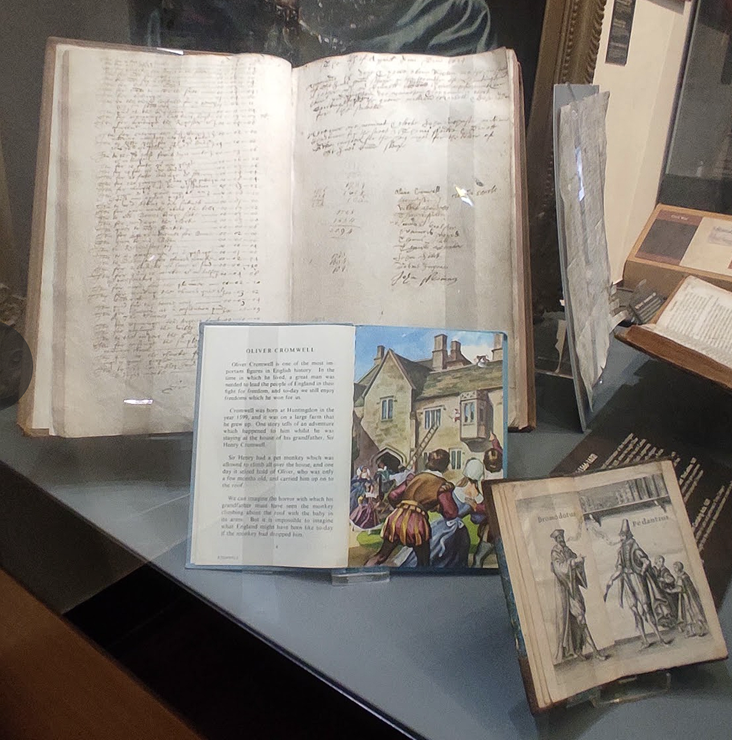
Not many museums include the Ladybird book on the subject alongside primary sources

This museum was a revelation: a great topic, fascinating and informative displays, interested and chatty staff, and the museum packed with visitors. I’ve been to many small museums in the past few years, and they are usually silent, well-meaning, but out of date. This one is a glorious exception. 

You would think that Cromwell is a sufficiently interesting topic, controversial even today, for any museum, but a contrast with the Cromwell House in Ely is very revealing. The Cromwell House is kitted out as a 17th-century domestic house, but contains nothing of relevance to Cromwell himself. As the staff in Huntingdon described it, they’ve got the building, but we’ve got the stuff. And so they do! Just one room, but packed full of items belonging to, written by, or associated with Oliver Cromwell. And not just meaningless memorabilia, for the most part.  Each of the bays shows a different part of Cromwell’s life, with the first bay showing a Ladybird book from 1963 about Cromwell, and the final bay showing his influence, including a model of the British Railways steam engine, the Oliver Cromwell, built 1951 (at which time it was clearly acceptable to name an engine after this controversial figure) and the title page of Carlyle’s Speeches of Oliver Cromwell’s Letters and Speeches (1845). 

Like many major figures, Oliver Cromwell means different things to different generations. I was fascinated not only by the way public opinion seems to have shifted from revulsion (after his death in the 17th century) to rehabilitation (from Carlyle and others) leading to his statue being placed in Parliament Square, where it remains today. For much of the 20th century he was a hero, if the Ladybird book (by I du Garde Peach, 1963) is anything to go by. The Ladybird book, ostensibly for children, begins: 

Oliver Cromwell was one of the most important figures in English history. In the time in which he lived, a great man was needed to lead the people of England in their fight for freedom and to-day we still enjoy freedoms which we won for us. [p4]

I'm not sure how many children would grasp this idea of freedom, and it's probably not how we would describe him today, and certainly not how the Irish would describe him, I would imagine. In academic circles, Christopher Hill represented the orthodoxy in the seventies and eighties, but today revisionist scholars such as Ronald Hutton seem to be in the forefront.


As for parallels with other despots, Cromwell appears to be more on a par with Lenin than with Putin, in that he at least started from a principled and justifiable position, even if he could not justify all his actions, whereas typical dictators act from self-preservation and appealing to the worst instincts of the populace.


Valiantly, the museum attempted to cover the historiography as well as the objects (paintings, hats, letters). In addition, the museum included a timeline of Cromwell’s life and contemporary affairs, several information boards, question-and-answer panels (“Did Cromwell abolish Christmas?”), together with the usual dressing-up items of armour and clothing for children, plus Cromwell tea towels and fridge magnets, and even ended with an illuminated quiz so you could compare your view of Cromwell before and after visiting the exhibition. 

Finally, as if that wasn’t enough, the museum had free admission (compared to £6.50 for standard admission to the Cromwell House in Ely), and stated it receives no government support. It sets a standard for other museums to try to match. There will never be agreement about a figure as divisive as Cromwell, but that’s no bad thing. On leaving the museum, there were campaigners in the market calling for an end to immigration and to “ideological teaching” in schools. I can’t help feeling that a museum like the Cromwell Museum generates reasoned discussion rather than mindless ranting. When I got home and showed my Cromwell quotations tea towel there was general derision in the household; but you don’t have to agree with everything he said to take him seriously.


Wednesday, 20 December 2023

Art Exhibitions of the year 2023


Elias, Bodegon, 1933

This year, I’ve written about ten exhibitions, ordered in approximately reverse chronological order of viewing: 

  • Frans Hals (National Gallery)
  • Real Families (Fitzwilliam)
  • Black Atlantic (Fitzwilliam)
  • Rubens and Women (Dulwich)
  • Morandi (Estorick)
  • Labyrinth (Fitzwilliam)
  • Sussex Landscape (Pallant House)
  • Islanders (Fitzwilliam)
  • Cezanne (Tate)
  • Feliu Elias (MNAC, Barcelona)

Of those, my top three were:

Feliu Elias, a painter I’d never heard of before seeing this exhibition, and what a revelation! A painter who could move confidently between cartoons, and still lifes and portraits in oil, and impresses by the seriousness and thoroughness with which he approaches both. The most mundane, everyday objects, such as saucepans, are treated almost with reverence.  

Rubens, for his ravishing depiction of women – even his works of classical mythology end up having the same figure as his wife. I don’t think the TLS review of this show (by Breeze Barrington) did the exhibition justice. She complained that the women in the paintings are “not the focus”, and  “it would help to say more about who they [the women in the paintings] were in their own right”. Yet we don’t ask Frans Hals (or any portrait painter) to tell us all about the characters. The job of the portrait painter is to bring the sitter to life through their expression, their form. 

Frans Hals, whose paintings stand out so powerfully that you can recognize then at the other end of a gallery. If portrait painting is bringing a figure to life, then Hals reveals a whole living world. 

All in all, a great year for art, even if (as I noticed most in the Real Families exhibition) there is an increasing tendency to curate art exhibitions by criteria very different to quality of the artwork - a rather worrying trend.  


Frans Hals: the man who brings the seventeenth-century to life


Hals, Portrait of Catharina Hooft with her Nurse, 1619-20

Frans Hals, National Gallery, September 2023 - January 2024: What a wonderful show! Hals is so unlike the typical C17 Netherlands artist. Most painted details; he painted people, with little or no background. Most painted interiors or landscapes;  he painted almost exclusively portraits, and even his portraits are unlike any of his contemporaries. Nobody had Hals’ spectacularly bold use of brushstrokes, nor his ability to capture character in a face, both males and (exceptionally) females. So many of his female faces are real people rather than figureheads, representatives of a social class, demonstrating their wealth and social standing. Of course he painted the wealthy classes, but you feel he has caught something of their character, that he is almost presenting them as an equal. 

Frequently, he manages to capture both social status and character, as if to say “you commissioned me to paint this person, but the money is only a small part of it: I have captured who you really are." Frequently, the character is brought it to life by the angle of the sitter, or a leaning chair, or their hand on their hips, or, in one case, by introducing another person, as in the Portrait of Catherina Hooft and her nurse.

What really hit me on leaving this exhibition was how tame other painters are by comparison to Hals. I found myself in the Italian Renaissance gallery, and apart from some late works by Titian, none of the other painters had Hals’ focus on individual figures, combined with such carefree, lively brushstrokes. It may simply be the difference between two eras, Renaissance and Baroque, but what a difference! What unashamed concentration on the single figure, seeming to breathe in front of the spectator.

Hals, Portrait of Susan Baillij, c1645, detail of gloves

A very telling anecdote suggest that Hals was anything but subservient towards his sitters. He abandoned a group portrait after executing around half the individual portraits, because he no longer wanted to travel from Haarlem to Amsterdam – he wanted his sitters to come to him. They refused; he walked away from the commission (and it was completed by another painter).

Some of his best works are small-scale, children and everyday figures. Memorable is the portrait of Jean de la Chambre, a calligrapher, who looks as though he has just been interrupted at his work. 


Hals, Portrait of Jean de la Chambre

While I’m not very keen on the idea of an artist’s late works being an indicator of great profundity, there is an even looser use of the brush in some of Hals late works that is simply astounding to observe. You have to approach these pictures very closely to see just how free the strokes are. One of the greatest is a portrait of an Unknown Man, in the Fitzwilliam Museum, painted around 1660. The sitter may be unknown, but his character is revealed at a mere glance at the painting. 

All in all, it felt such a privilege to share the vision and insight of this remarkable artist, who brings to life his sitters like nobody else.