Monday, 22 March 2021

What happened to the provincial art gallery?

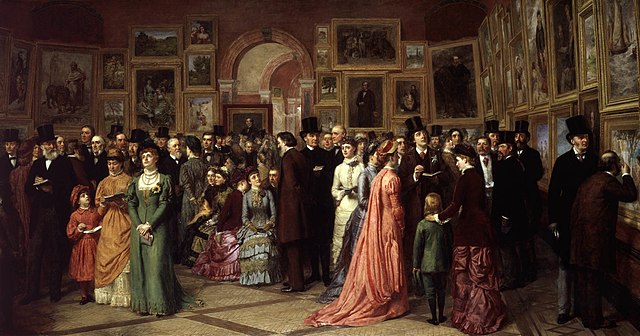
Frith, A Private View at the Royal Academy, 1881

What could be more pleasurable than the discovery of a new art gallery, especially if they have a café attached, so you can indulge yourself in a fantasy world of coffee, cakes and fine art, utterly shut off from the reality outside?

It wasn’t always like this. Outside of the UK, few galleries had cafes, and galleries have not until recently been pleasurable spaces to visit. 

Nor was I aware that they formed the subject of academic studies. I wasn’t aware of studies of art galleries, for example, the ideas behind their foundation, typically in Victorian times, until I came across a review of a book by Giles Waterfield, The People’s Galleries: art museums and exhibitions in Britain, 1800-1914 (2016). Sadly, this book is only available at crazy prices, so I have no chance of getting to a copy of it. But a TLS review, by Susan Owens, raises many points and makes it clear how the world in which these galleries were founded is very different to today’s world. And it’s not just the absence of a café.  

What factors led to the mass of local art galleries that we see today? The rise of an urban middle class, no doubt, the existence of learned societies perhaps less so, since there is no municipal art gallery in Spalding or Saffron Walden, despite those places having societies. The 1851 Great Exhibition was undoubtedly a spur, followed in 1857 by the Manchester Art Treasures Exhibition.  Waterfield himself states “It was on the foundations of such exhibitions – entrepreneurial, commercial, entertaining, accessible – that many provincial galleries were built.” 

How many of those adjectives apply to today’s public galleries? The provincial gallery has no hope of running a full commercial operation; it would not be possible to cover their running costs. I would guess that every public art gallery is subsidised from various sources. So if at all “entrepreneurial”, the gallery typically focuses on obtaining more funding wherever possible, rather than going all out to charge the visitor. 

Some initiatives are visible. The museum café, a bookshop and giftshop, and paid exhibitions are the most obvious initiatives. Oxford’s Ashmolean Museum had a vast extension built, partly to enable the museum to mount paid exhibitions – but whether those have generated substantial revenue is, I think, unlikely. One or two of their exhibitions might have made money, but that success has to compared to other exhibitions with only a tiny attendance, as far as I could see. London and Paris have a substantial gallery-going public who think nothing of paying hefty fees to see an exhibition if they think it is culturally important. Does a similar audience exist outside London?


But there are other, more fundamental differences from the art galleries founded in the 19th century and the gallery of today.  Susan Owen writes: 

When the Atkinson Art Gallery – a gift to Southport from the cotton manufacturer William Atkinson – opened in 1878, it had not a single work of art. Undeterred, the gallery sent out a circular to residents requesting loans for an inaugural exhibition, which turned out to be triumphantly successful, with over a thousand works lent to the gallery. 

Would the same thing happen today? I think not. The general public has abnegated any belief that they can arbitrate in the common taste. Nobody would dare offer the pictures from their living room to the Fitzwilliam; for the most part, that’s not the kind of thing the Fitzwilliam shows. Since 1878, we have lost (or at least we suppress) the feeling that we can participate in choosing the works that enter a gallery. 

Yet we may (sometimes) pay to participate in the cultural good of the collection. In the USA, payment is the norm, even if admission to the major collections is free for certain groups, such as army veterans. I didn’t see many veterans in the Boston Museum of Fine Art the day I was there. Denmark, the Aarhus Gallery, Aros, is a stunningly successful example of a paid gallery. It would appear the Danes have an insatiable appetite for a stylish art collection. When I last checked the figures, it had double the number of visitors of the Fitzwilliam per year, even if I am rather dubious about the claim on its website to be the most visited art museum in Scandinavia. Most of the publicly funded galleries in the UK are free; there would be an outcry if they introduced a charge. 

However, having free admission does not mean that the galleries provide equally for all classes. Early galleries tried for inclusiveness through extended opening hours into the evening, “to accommodate working men and women” (from the TLS review). Although the modern UK art galleries are largely free to access, I don’t see much sign of the working men and women. 

Is there a difference in what the galleries buy today with the Victorian heyday? Of course, the cash-strapped state of Britain today means that few galleries are buying art, tasteful or otherwise. And the 19th-century solution of art presented to the galleries by rich patrons seems non-existent. “More controversial works of art were being bought by Northern Industrialists … whose eye for detail and craftsmanship was amply rewarded by Pre-Raphaelite paintings.” Precious little sign of either the taste, or the purchasing, today. What industrialists like, and what galleries want to show, are a long way apart. Perhaps it is similar to the process of gentrification of inner cities: the museum remains, but no longer addressing the locality it serves. 

So is that it? Apart from the coffee shop, are the provincial galleries out of touch with their catchment area and their locality? Has culture drifted apart so much that what people want to see differs fundamentally to what the gallery wants to show? The present-day provincial art gallery inhabits a world of great uncertainty. Few museums seem to match the ability of the Whitworth Art Gallery, Manchester, both to genuinely engage with their local population, and also serve great coffee.


Tuesday, 16 March 2021

How to make a comedy fall flat


Judy Holliday, Broderick Crawford and William Holden in Born Yesterday (1950)

This film appeared on a BBC-curated list of the top 100 comedy films of all time. Given that recommendation, perhaps you would expect the film to be full of jokes from end to end. But the humour became rather subdued as the story proceeded, and by the end, few viewers would have called this a comedy. Unless you describe a monster hitting his girlfriend entertaining.

The plot is simple: this is a Pygmalion tale updated to the United States of the 1940s. A fabulously wealthy self-made man is visiting Washington to ensure greater market domination for his business. He is accompanied by his girlfriend, who is the focus of the story.  Like him, she lacks education and social breeding, but unlike him, she cannot even appear to be polite for a moment, and her lack of any experience in upper-class company is wonderfully entertaining as she tries to make conversation with a congressman and his wife. The plot is her partner’s attempt to educate her, a task he delegates to the wonderfully elegant and urbane journalist (William Holden) who has come to interview him.

So far, so good. The couple’s boorish behaviour (they shout at each other, and he mistreats the servants) is initially entertaining. The journalist, Paul Verrall, shows her the sights of Washington: he takes her to museums, to the Capitol, gives her books, and helps her read the daily paper. Suddenly she acquires an enormous dictionary, and starts to read all the papers placed in front of her, and starts to question her relationship with her abusive partner.

With an astonishing tour-de-force interpretation by Judy Holliday, the film could not fail to be funny. But, as mentioned above, the comedy starts to wear thin at this point. The film fails to maintain its light-hearted view of the couple. As Billy Dawn looks more closely at her partner, she doesn’t like what she sees. Nor do we respond very comfortably to a polished journalist trying to teach Billie how to live. She was inferior in her relationship to the bully, and she remains inferior to the journalist, who holds all the trump cards. This is not a relationship that will work, except in film (La-La) land.

The remaining 30 minutes or so are disastrous for the film. Unlike films such as Some Like It Hot, where the comic tone is maintained throughout, despite gangsters killing each other in full view, Born Yesterday feels the need to get sentimental about the American system, and to abandon the comedy to start telling the truth. Except that the American system is described so lovingly, and so falsely:

Paul: The whole history of the world is a story of a struggle between the selfish and the unselfish.

Billie: I can hear you.

Paul: All that's bad around us is bred by selfishness. Sometimes selfishness can even get to be a cause, an organized force, even a government. And then it's called fascism. Can you understand that?

Billie: Sort of.

In any case, the scenes set in the Capitol building have been changed forever by the sight earlier this year (2021) of marauding rioters occupying the Capitol. We don’t believe the lies (did anyone, ever?) told us about the US democratic system, and we feel uncomfortable that this comedy has suddenly turned very serious. So, while we can live with such lines as Billie, discovering herself: 

Billie: I don't know if it's good to find out so much so quick. 

We wince at the complacent, smug attitude that writes off corruption as “one bad apple”.

But, hell, in the end, I can’t deny there are lines in the script that are unforgettable: 

Harry Brock: Listen, cutie, don't get nervous just 'cause you read a book. You're as dumb as you ever were.

Harry is a monster, and the plot doesn't have to lose all the jokes to convince us that he is a monster. If only the plot had remained on this level, we would still be watching the film today. As it is, the tone of the last 20 minutes of the film is simply an embarrassment.


Tuesday, 2 March 2021

Does dumping really exist?


Photo by John Nyberg at FreePhoto.org


Dumping, in economics, means the selling of goods or produce cheaply in another market from the one in which it was produced.  It is a common claim by politicians that another country is dumping goods or materials in the home market. 

Dumping forms the subject of the recent, widely praised book, Trade Wars are Class Wars (Matthew Klein and Michael Pettis, Yale, 2020). It is used to explain much of the malaise of the modern world.

But does dumping actually happen? My feeble attempts to learn economics don’t seem to have said much about dumping – or perhaps I just wasn’t listening for that lesson. Let’s start by seeing what the orthodox theory is and then how it might be applied.

 Here’s what the Economist Dictionary of Economics says by way of definition:

 Selling something for less than the cost of producing it. this may be used by a dominant firm to attack rivals, a strategy known to antitrust authorities as predatory pricing. Participants in international trade are often accused of dumping by domestic firms charging more than rival imports. Countries can slap duties on cheap imports that they judge are being dumped in their markets. Often this amounts to thinly disguised protectionism. In practice, genuine predatory pricing is rare - certainly much rarer than anti-dumping actions - because it relies on the unlikely ability of a single producer to dominate a world market.  

So, according to the economist, you would need to dominate a world market to create predatory pricing.  

Here is the website Economics Classroom definition:

The practice of producers in one nation selling their output at a price lower than their costs of production in another nation. Considered a justification for protectionism by the World Trade Organization.

 I still don’t get it. Which country can afford to sell off its products for less than the cost of production?

 According to the book Trade Wars are Class Wars, dumping dates back to J A Hobson’s book Imperialism (1902). Hobson’s idea was that British mine owners made great efforts to sell manufactured goods in the colonies such as South Africa, while neglecting investment and living standards at home.

Now, I can understand the business practice of would-be monopolists such as Standard Oil (in the early 20th century) and Uber (in the 21st century). Both of them reduced prices in target markets to drive out competition, in the expectation that they could raise prices subsequently. But could any Chinese company (say) afford to flood the European market with such cheap steel that all the European producers went out of business? Or, perhaps more likely, if the European producers are not as cost-effective as Asian companies, it would be economically better for them to cease producing steel, as long as the resulting market left competition available – and steel is produced in Korea, China, Australia, and many other countries.

In short, I am not convinced by the dumping argument as practised by a nation state, although I can believe it if practised by a corporation. 


Sunday, 28 February 2021

Calvino, Stereotypes and Misogyny

The stepmother greets Hansel and Gretel. Illustration of Grimm's tale by Henry Ford (c1891)

I mentioned in earlier posts that Calvino’s Italian Folktales has considerable stereotyping. Looking back after reading the entire collection, I notice that although he is a conscientious and thoughtful editor, in his notes he praises any detail except the glaring attitudes to women. I’m trying to identify which, if any, of these tales I could tell my grand-daughter, and I’m struggling. 

I was able to find one scholarly article about the Italian Folktales, by Martin Beckwith (1987), which looked at a few tales in detail and identified how Calvino had changed them. The changes included making some of the tales slightly less gory and violent, not dissimilar to the Grimm brothers in their retelling. However, the Grimms were writing in the late 18th and early 19th-centuries. As a 20th-century editor and commentator, would you not feel it appropriate to address the misogyny? Do we believe that the inherent nature of folktales is that stepmothers are evil and most old women suspect? If Calvino had left his stories untouched, he would not have invited criticism of this kind. But he clearly felt entitled to edit them, so I believe he bears some responsibility for the stereotyping he is consciously transmitting. 

As for other stereotypes, I used a digital edition of Calvino’s Folktales to identify that nine of the stories feature stepmothers. All of these references are to evil stepmothers. For example:

[52] One day the stepmother slapped her for breaking a bowl, and Stellina left home, unable to endure any more.

[82] As soon as the king was gone, the stepmother queen went to all lengths to get into his room. She put opium into the wine of his servant …

[95] the stepmother beat the poor girl every day.

[121] The son remained with his stepmother, who paid him no mind whatever, since she was in love with a Moor and had eyes only for him.

Calvino is not alone in ignoring the stereotyping; many modern commentators seem to do the same. The Cambridge Companion to Fairy Tales (2014) has just one incidental reference to “misogyny” or “misogynist”. Is that not a key question to address in any modern-day evaluation of the fairy tale?

I am not advocating censorship of literature. We recognize aspects of Shakespeare that do not conform to modern values. But in the restricted world of the fairy tale, the message is hammered home in story after story. You could even say the primary message of many (most?) of the tales is for the hero (usually male) to find a rich or titled wife (who typically has little or no choice in the decision) and to overcome the obstructions of stepmothers and other miscellaneous curses. I'd love to explore how many violent deaths occur in the tales to women, and how many to men. 

Perhaps the only response possible today to the traditional folktale is to follow Angela Carter and to rewrite the stories completely to fit 21st-century values. Should we abandon traditional fairy tales and folktales? I am waiting to be persuaded otherwise.


Monday, 22 February 2021

Final judgement on Cnut the Great

Cnut and his wife Emma, from the New Minster Liber Vitae

Having now finished Timothy Bolton’s biography of Cnut the Great, I can’t resist appending to my earlier post with some additional points. 

The conclusion should be at the start

Bolton’s five-page conclusion makes the life of Cnut much clearer. General readers would find it easier to have this as an introduction or first chapter.

 Get beyond “Englishness”

For much of the book, Bolton admirably examines Cnut both from a Scandinavian and an English point of view. I haven’t read many books about early English history, but I expect the typical book by an English author will look at English sources, and not consider events and sources outside England. But sadly, at moments in this book and in the very last page of this biography, Bolton comes dangerously close to falling into the trap of nationalism. I simply don’t believe that a ruler like Cnut will have seen “English” and “Danish” in the way we regard these terms in the 21st century: 

England may have been of crucial importance to him, but he seems to have remained at heart a Scandinavian. [p129] 

That is not to say that Cnut did not strongly feel himself to be Scandinavian or that he did not really wish to embrace Englishness [p213] 

I don’t imagine William the Conqueror was too bothered about embracing “Englishness”, whatever that is, and I don’t imagine that Cnut was very interested in it either, apart from the political benefit of appearing as the right kind of ruler. In fact, being able to tell the English what they wanted to hear, and the Danes what they wanted to hear, even if it was diametrically opposed, is what strikes me as modern about Cnut. 

Use a contemporary image of Cnut

I mentioned in an earlier post that the book uses a cover image dating two hundred years after Cnut's death. Bolton presumably sanctioned the use of this anachronous depiction of Cnut as a knight in medieval armour, while he includes a fascinating contemporary image of Cnut as one of his plates. He states, on page 192, “This is one of the most widely discussed drawings of Anglo-Saxon history”. A section is shown at the top of this post. .

The British Library states the illustration is “near contemporary”. Talking of dates, this book is maddeningly vague about dates; it doesn’t give a date for the illustration.

The historian’s innocence

Sadly, the author reveals a charming innocence when it comes to evaluating Cnut. He is convinced that Cnut became sincerely religious later in his life. For evidence of this, Bolton mentions the gifts Cnut lavished on English religious institutions. What motivates philanthropy? 

M.K. Lawson suggested in 1993 that many of Cnut’s gifts to the Church may have been politically motivated, and I later followed that approach myself. To some degree we were both probably correct, but genuine piety sits at the heart of an array of sources close to him, and Church gift-giving must also have been a powerful force behind this benevolence. [footnote: A mix of the two motives is perhaps characteristic of almost all medieval donors.][p183] 

I find this astonishing. Bolton gives ample evidence of Cnut’s astuteness (he calls Cnut a “diplomacist”, not a term I have found in a dictionary) yet is convinced he was sincerely Christian. I’d want to see more evidence than giving gifts to churches. 

Cnut turning back the tide

Like it or not, this is what most people think they know about Cnut. Clearly, from Bolton’s description, it is based on a wrong reading of the texts. But to place this in an appendix and footnotes is rather childish. Bolton justifies his decision thus: 

I beg my reader’s forgiveness for my irascibility on this front, but when one spends the better part of one’s adult life researching Cnut, it is the first thing anybody asks you about, and it become as irritating as a stuck record. 

Find a copy-editor

The book would benefit greatly from an editor able to remove some of the unique word forms (“eschelons”) and dead phrases. The quote above mixes “one” and “you”. Another quote above describes “the heart of an array of sources”. Some more examples: 

It in the field of international politics … where we can see that Cnut … ploughed a novel and quite opportunistic furrow. [p158] 

It’s a shame, since the underlying research looks so good, that the book loses the reader in details, when it would be simple to provide a few signposts.


Wednesday, 17 February 2021

How great was Cnut the Great?


A 13th-century illustration of Cnut in combat with Edmund Ironside

We hear a lot about the growth of scholarly publishing but even so, it’s not every day that a new book is published about Cnut the Great. It seemed like a good opportunity to find out if Cnut was a candidate for greatness. After all, he successfully invaded England less than a hundred years before William the Conqueror, but somehow the date of his invasion (1013) is not known by everyone in the way that 1066 is. 

This book (by Tim Bolton, appearing in the long-lasting series “Yale English Monarchs”) got good reviews, but the experience of reading it, for this non-specialist reader, was decidedly mixed. It would have been so easy to make the book more accessible.

·       The author must assume we know the main facts already, but I’m afraid I did not. Why not add a chronology of major events? I kept having to check the Wikipedia entry for Cnut to establish where we were.

·       The cover illustration, although it may be referring to Cnut, dates from two hundred years after Cnut’s time. We are quite certain that Cnut did not wear clothes like that. Could an illustration not have been found that was contemporaneous with Cnut?

·       Speaking of illustrations, you would have a hard time trying to link the photos with the main text. There are eight pages of black and white photos, but it seems beyond Yale University Press to indicate in the text where the images might be. For example, a pencase lid was found in a 1961. “Reproductions of both its upper and lower faces are given here in this volume”, states a footnote on page 142. Why so coy? It is plate 4. Here we are in 2021, and book publishing hasn’t yet reached the point where the text can refer to the illustrations with any certainty.

Much, perhaps most of the book is conjecture. This is unavoidable when writing the life of someone for whom so few sources remain. But it leads to a lot of hypothetical assertion.  As an example of “history as it could have been”, how about:

Harald’s death must have had a profound effect on Cnut. In England in 1018 he cannot have expected that Harald would be dead within a few months, and indeed as his brother must have been in his twenties or very early thirties, it was unlikely. The emotional toll may have been great. The brothers seem to have been close. [p131]

As if that isn’t uncertain enough already, a footnote adds: “No source records Harald’s age, but he is unlikely to have been many years older than Cnut, who at this stage must have been in his twenties.”

 The book is an uneasy mix of an academic article, disputing with other scholars, and a general introduction. For a general work of history, I would not include the names of any of the recent scholars in the body of the text. If the author wants to cite the attribution, it can be done in the footnotes. Discussions with other scholars are for academics to argue in journals, not for a biography of this kind.

·       The index is of proper names only, and pretty selective at that: there is no reference to “English Channel”, or “North Sea”, or “Kattegat”. Yet there is an entry for London. The index appears to suffer from an unconscious English bias. There is no entry for Aarhus or Fyrkat, but there is an entry for Abingdon Abbey. Who makes these decisions?

·       In contrast, the footnotes frequently contain material that is highly relevant for the main argument. These should be promoted.

·       There are just two not very adequate maps, one of Denmark, one of routes from Northern Europe to Rome. No map of England, or maps of the places mentioned in the text.

·       There is a fascinating introduction, but this combines a real overview (very helpful) and a detailed description of sources (very intricate, valuable, but making little sense to the general reader until the relevant source is mentioned in the text)

Is the book worth reading? Absolutely! It makes effective use of whatever sources it can find, including archaeology, coins, and poetry. Most impressive, to my mind, is the way it makes a determined effort not to interpret the life of Cnut, a Dane, into the standard narrative of English history, making so many unstated assumptions about the national heritage. Because the English sources are so much more substantial than the Scandinavian records, Cnut tends to be seen through English eyes, but he seems to have been equally at home in England or in Denmark. His life is a fascinating example of monarchy in the days before the nation-state became implanted on everyone’s brains. Finally, mercifully, there is no mention (at least so far in my reading) of the one “fact” that everyone knows about Cnut: his trying to stem the tide.


Thursday, 31 December 2020

Books of the Year 2020


Some of the books of the year - I tend to give away the books I enjoyed most, so this is an incomplete selection of all the chosen titles. The best ones always get away!

Not much to celebrate about 2020, which went downhill from March onwards with coronavirus and final stages of Brexit, but despite everything, there were some books I encountered during the year that were truly inspiring (and some of them I even finished). Here is a quick list of eight books (and one art exhibition) that impressed, entertained, or challenged, and all took my mind off other things. 

Norman Scarfe (ed), A Frenchman’s Year in Suffolk, 1784

This book only arrived in December, but already it has proved fascinating. Norman Scarfe is no doubt a monarchist, a reactionary, and against everything the French Revolution stood for, but I forgive him everything for bringing to life the diaries of the La Rochefoucault brothers during the year they spent in East Anglia. Their accounts of the everyday life of the English upper classes – their drinking, their hunting, and their impoliteness – is a wonderful corrective to the accounts of insiders such as the dreadful Parson James Woodforde, writing at a similar time, but utterly complacent and self-serving. Scarfe’s edition is a model of good scholarship: everything explained at the foot of each page, with illustrations of people and places, and a scene-setting introduction. It’s lovely to see this book has been reprinted four times since its first publication in 1987. 

Grace Paley, Collected Stories

What a discovery! She wrote only three collections of short stories, in 1959, 1974, and 1985, no novels, and yet managed to write pioneering experimental fiction, as well as being a political activist and campaigner. Her stories draw on her lower-class Jewish background in the tenements of New York, with many of the characters reappearing in several stories. She is never afraid to experiment (which means that some of the stories go nowhere, or simply fall over) but you forgive her for the success of some of the other stories. These stories have an immediacy, a vividness, that grips the reader, in great contrast to the more leisured, cossetted atmosphere of Updike. You suspect that for every Updike there is a Grace Paley somewhere looking after the kids and writing on the kitchen table. Best of all, Paley has no axe to grind; she writes believable fiction, not to prove a thesis. And her dialogue rivals Damon Runyon’s!   

Calvino, Italian Folktales

This vast collection of hundreds of tales constantly defeats my expectations. I’ve written about it at length elsewhere; suffice it to say here that I find it is consistently entertaining, while ploughing through collections of Grimm or Afaneseyev’s Russian folktales becomes heavy going.  However (two weeks later), just a minor update, after having read 155 of the 200 tales: I wish Calvino had exercised a little more rigour in his selection. Several of the tales repeat elements found elsewhere, and are not great tales in their own right. I think the selection could have been further reduced by around 20%. It would still remain the definitive selection of Italian folk tales. 

Susan Woodford, Greek and Roman Art (2020)

A real achievement, this one, in a series by Thames and Hudson, entitled Art Essentials, along the lines of Gallimard Decouvertes. There are plenty of introductory guides on the subject, several of them by Susan Woodford herself, so this one should have been unmemorable. What made it stand out was that is in full colour, with an integrated layout, with the excellent choice of illustrations, captions that read as if she has actually looked at the work in question (“the elegant pose of the statue folds into unintelligibility”), a good glossary and further reading section. All in all, a highly successful use of the concise format to focus on the essential artworks and artists. Very easy to read, and very inspiring to make me want to go and see some of these things in museums. 

Tolstoy, War and Peace (1869)

It may be thought cheeky to select a book that I’ve only read a few hundred pages of. Given the size of the novel, however, these few hundred pages are as long as some novels. And you can already see some themes emerging. You notice the omniscient narrator, who tells us what to think, for example, that we should be fond of Pierre, and that we should see the social life of the rich in Moscow and St Petersburg as shallow: “Here in Moscow we are more occupied with dinner-parties and scandal than with politics.” It’s a clever trick, to give the appearance of neutrality, but to lead the reader by a hundred signs into agreeing with Tolstoy’s often peculiar ideas. 

Tim Parks, Medici Money (2006)

Medici Money is my nomination for book of the year. Discovered in the Amnesty Bookshop, Cambridge (remember second-hand bookshops?), at a price of £3, Tim Parks’ Medici Money turned out to be a real page-turner – pretty impressive when you think it is a book about banking and economics! But the combination of Parks’ accessible but informed writing style, and the astonishing subject matter, made this book a winner. I will never again look at the word “Medici” without suspicion, and the book has changed the way I see the Renaissance in Florence. 

Machiavelli, Florentine Histories

Inspired by Tim Parks (above), we read the first two hundred pages or so of Machiavelli’s Florentine Histories. The pattern seems to be clear: the city of Florence places its hopes in an individual or group to free them from a tyrant, only to discover that the resulting political situation is worse than ever. Unfortunately, the edition was a rather stodgy and unhelpful one. You need some assistance to make a contemporary historian accessible.  

Van Eyck exhibition, Ghent

This was certainly the exhibition of the year, even if the show was rather distorted into comparison of Flemish versus Italian art, with the winner being, of course, Van Eyck, the local; I wrote about it here.

Defoe, Captain Singleton (1720)

Defoe is remarkable for writing fiction that seems amazingly realistic, despite his not having any experience of the situation describe. Here, Captain Singleton is a pirate who crosses Africa from east to west with his band of followers. 

A Much-maligned town: Opinions of Reading 1126-2008 (2008)

chose this book as a tribute to the small publishers across the UK who produce books about a place, for a local readership. Reading, not a city that you would immediately associate with publishing, has one of the best local publishers, The Two Rivers Press. I don’t see any truly local publishers like this in Oxford or Cambridge, which is a shame. Plenty of publishing about the universities - but that's not the same thing.