Sunday, 12 May 2024

How to read a book

Reading a new book is a bit like encountering someone new. Your view of the book, or the other person, is at first rather cautious; you don’t want to trust this new resource too much until you have a better view. Initially, you have probably heard something about the book, perhaps a recommendation from a friend, or a review, or the subject matter, or even, heaven forbid, the jacket design, appealed to you. Whatever the case, you retain an element of uncertainty before you fully open yourself to this book. You ask yourself, I will devote several hours to this book, so I want to think it will be worth it. How, in other words, do you assess a new book? Let’s take an example: The Seduction of Place (2000).  

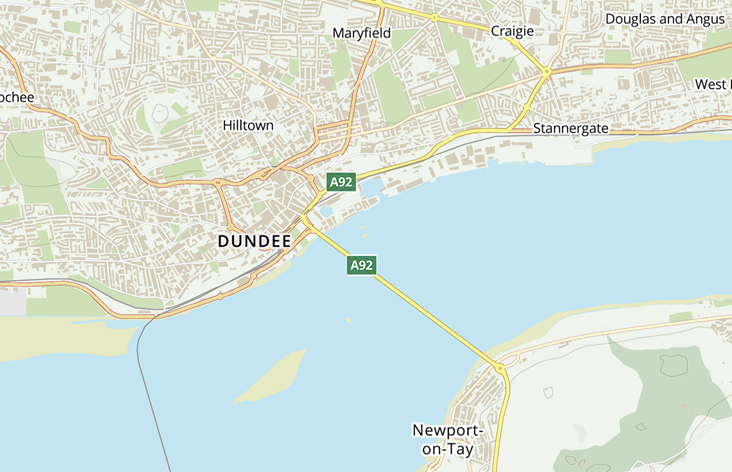
I live in Cambridge, which for possibly accidental reasons is situated quite close to several new and planned cities: Milton Keynes, Letchworth, Stevenage, Harlow and Peterborough, to name a few. Does this conscious urban design make people happier? More broadly, what is the relationship between cities, their buildings, and their inhabitants? When there is a new development, such as a shopping centre, or a bypass, or a community garden, is there any way to measure the effect on the inhabitants? I recently visited Dundee, and in my opinion, the siting of the new Tay Bridge bringing traffic to the middle of the city centre had a disastrous effect on people’s lives.

So I was looking for a book that  examined the relationship between the built environment and people’s lives. I want a stimulating but entertaining read.

Joseph Rykwert’s The Seduction of Place (2000) struck me as a possible answer to these questions: the subtitle is “The History and Future of the City”. The blurb for the book describes how Rykwert “assesses how and why urban projects from the past succeeded or failed and what lessons can be drawn”. That sounds like the right book to me. He is a respected writer (Wikipedia describes him as “one of the foremost architectural historians and critics of his generation”). There were no fewer than fourteen plugs (praise from reviewers) for the book on the covers and the first page, and the twenty-eight people thanked for their comments by the author before we get to page one. I had a train journey, so I took the book with me and settled down to be instructed, and hopefully entertained. 

It seems a bit churlish after all that to say I was disappointed. There is no question of the author’s learning; perhaps indeed that proved to be the challenge. 

My method for appraising a book is simple. I proceed on two fronts. The first assessment is at the macro level, the same as the appraisal of a journal article: is the author answering the question proposed by the title? One would hope, both for articles and for books, that the question may need some elucidation, despite the presence (for the journal article) of an abstract, but it seems pretty clear that this book is about “the history and future of the city”, as the strapline states. But after fifty pages, I had discovered some points about the history of the city, but almost incidentally. I wasn’t sure what the first 75 pages, around a quarter of the book, were for.

If this is a book about the history and future of the city, do we need to have a chapter devoted to the Industrial Revolution? Do we need to have a potted history of agriculture? Do we need to know the details of why Voltaire and Rousseau came to Paris, and why they didn’t like it? Do we need the details of Pugin’s Contrasts, which I have never envisaged as a study of things urban? In Rousseau’s case, his reason for coming to Paris was to earn enough money so he could leave and write his Confessions. Fascinating - but irrelevant. Here is part of the passage devoted to Rousseau, to show Rykwert’s fascinating yet rambling style:

As Rousseau admired Turin, so Voltaire admired London as the model of a truly meritocratic city. And he was right, since even the pre-Hanoverian English crown never succeeded in establishing a powerful centralizing court, though the Stuart kings tried, and one of them, Charles I, lost his head in the process. Their failure was clearly represented by the ramshackle modesty of the palaces at Whitehall and Saint James’s, which were never aggrandized, despite plans to do so and reconstruction after fires. This was the great age of European palace building when very modest sovereigns indeed, like the prince-bishops of Wurzburg, built themselves residences the British Empire would never equal (p22).

This is an aimless walk rather than an argument.

Secondly, I read a book on the micro level, examining each sentence. when I encounter a statement about which I have some knowledge, I compare what I know with what the author knows. Or, simply, I use my common sense to ask “is this statement likely?... Am I satisfied that  this author is using reasonable argument to make his point?” It’s somewhat like a conversation with a taxi driver. You exchange a few platitudes, and then the driver launches into his theory of why the country is going to the dogs  - and you bite your lip and keep quiet for the rest of the journey.

Here are a couple of examples of Rykwert’s detailed statements. On page one, the author describes the situation at the end of World War Two:

Building became the highest social priority: in the first half of the century, any young man in a Latin-speaking country, whether in Europe or South America, who needed a university degree but had not special interests, often studied law; but after 1945, many of them gravitated to architecture.

This is a strange, rather cavalier claim. I’m confident to think there was an increase in the number of students studying architecture, but moving from law to architecture? Why from one to the other? Why “young man”, not “young woman”? What is a “Latin-speaking country” anyway, and why just these countries? Does Rykwert mean Spanish, or classical Latin, which hasn’t been spoken for over a thousand years? Did people not study architecture in Japan or China after 1945?

Rykwert refers to the computer game SimCity (not Sim-city) and misrepresents it. SimCity is an exception among computer games in that money is not the only measure of success; it is an attempt, simplistic of course, to create a simulation of managing a city that takes into account multiple factors, including providing work, leisure, transport, and attempting to keep the population happy by reconciling these often conflicting goals. For Rykwert “because the computer has to quantify, success and failure cannot be measured in more complex terms”. In contrast, SimCity measures success by a range of criteria, just as a city authority has to. I don’t state that it is perfect, but it is certainly about more than money. It is a remarkable  simulation because it presents the player with difficult choices: there is no single way to build a city successfully.

Rykwert’s book is an interesting comparison with a typical journal article. STEM (science and medicine) articles make claims and attempt to provide evidence for each statement they make. By contrast, Rykwert’s style is to proceed in an ambling fashion, introducing many details that are neither to the  point nor evidenced. An example is a paragraph devoted to the epic poem Gilgamesh, on page 13. Ostensibly, this is included because it is a conflict between the “urban” Gilgamesh and the “nomad” Enkidu, leading the author to link it to examples of rulers being reminded of their rural origins. How did we get here? Before I come to terms with that paragraph, I encounter another discursion into Hesiod’s ages of gold and iron, and then to Atlantis, and so on, for a further three or four pages, until we come to a theme: “what strategies are open to citizens who wish to shape their habitats in ways that would conform more closely to their wishes”.  That question is not the same as the subject on the cover. It’s an interesting topic in its own right, but it seems to reveal the rambling, discursive technique of the author, like a long Sunday supplement article where you keep reading because you like the author’s style. Personally, I’d prefer to state the subject and stick to it, and to reduce the discursive rambling.


Friday, 10 May 2024

The Voices of Morebath: an elegy for a lost Catholic England?


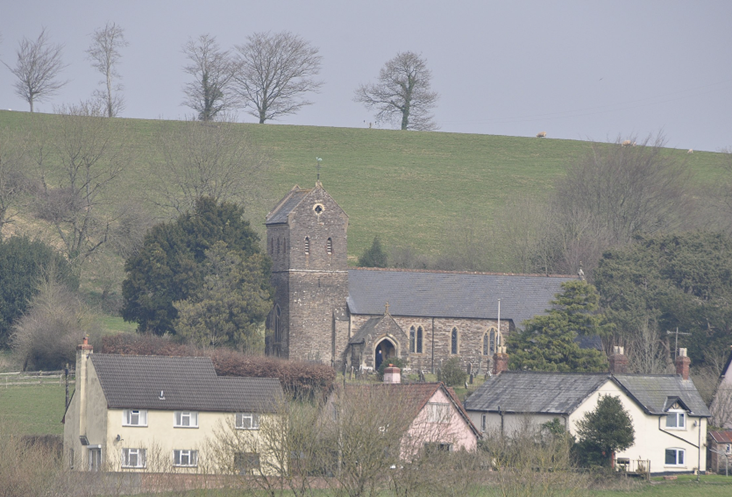
Morebath Church, photo by Lewis Clarke (CC BY-SA 2.0). The church and tower will have been familiar to the people described, but of course the objects within have long since disappeared 

Eamon Duffy’s The Voices of Morebath (2001) is a real gem. Using the remarkable survival of parish records for one small Devonshire village of 33 households, Duffy provides a history of the English Reformation, but not from the top, but this time from  below. In this book, we are down to counting individual sheep and altar cloths. The local saint, St Sidwell, plays a major role, before being written entirely out of the script by the end. The records exist for the 54 years when the priest, Sir (the title is apparently traditional for a priest at the time) Christopher Trychay (pronounced “tricky”) was vicar of the parish. 

Duffy is a Catholic, and for much of the book, it reads like a lament for a local community that was surprising for the extent of social activity and generosity. The author himself describes the book as exploring “the world-view which was the religion of most English people on the eve of the Reformation, and impact of radical religious change on the majority who would have liked things to stay more or less as they were.”  The parish records record the existence not just of the church wardens, roles that still exist today, but as many as six separate groups of parishioners, some of the men, and some women’s groups, all raising funds and carrying out activities for the community, but primarily to embellish the church fabric and altars. Reading it, I kept thinking of two comparisons. First, obviously, comparing tiny Morebath to present-day local groups here in the centre of Cambridge: the local residents’ association, and local politics, and the extent to which residents combine (or don’t) for some collective action. Like many historians, Duffy presents before us an image of a kind of golden age, partly created through the exceptional vicar, who captured so much of the life of the village.

Second, there is the obvious contrast between Catholic and Protestant England. The transition was very messy, with interludes (under Edward and Mary) of undoing everything that had been done by their predecessors. What makes this book exceptional is the questions it raises. To his credit, Duffy at the end moves slightly away from the simplistic vision of a local Catholic golden age , but in so doing, leaves this reader dissatisfied with the sudden reversion to the big picture. After chapters full of painstakingly documented evidence of how the village was happy to remain worshipping saints (including St Sidwell) and keeping candles burning for them, we suddenly shift to grand statements such as “a sign of the deepening gap between rich and poor which marked and darkened the hungry later years of Elizabeth”. With that sentence, the spell is broken; we want evidence, we are no longer satisfied with such wide-scale assertions. There are disturbing mentions of the introduction of a “cucking stool” late in the period, for the punishment of women, and a reference to historians who feel it indicated something wrong in the social order. 

And, indeed, this book makes you start to think about the astonishing changes during 16th-century England. In 1500, church building and church adornment was still part of every town and village activity. But at some point in the 16th century, church building in England more or less came to a halt. It wasn’t just the abolition of chantries and saints’ altars, it was a complete cessation of new sacred architecture (the only exception was tombs for the rich, something not mentioned by Duffy, probably because it doesn’t appear that the church of Morebath ever had any such grand tombs). 

For any history book to inspire the reader to see a moment of vast societal change is a great achievement. I can hardly complain if Duffy leaves me in the end unsatisfied, because I can’t help feeling there is more to the story than he reveals. The book raises so many questions! At the start of this book, this tiny village was dedicating a large portion of its surplus revenue to adorning the church building. By the end of the 16th century, condemnation of “popery” was universal and popular. How did popular opinion move so dramatically away from Catholicism? I don’t mean the major beliefs, but the seemingly abrupt change in popular feeling. And how could an entire population switch so dramatically from building and adornment for faith, to the feeling that plain walls and lack of decoration were somehow better? And how could the priest switch so decisively from promoting Catholicism to the latest version of orthodox Protestantism? It was the same vicar, before, during, and after the events. Duffy talks about the secularisation of the church accounts, but leaves me wanting much more. Sentences such as this leave me gasping for more information:

The process of secularisation of the parish was more than all this: it was in train before the break with Rome … it owes as much to the extension of strong government, and the  multiplication of responsibility within local community, as to any ideological shift. [p282]

That seems at odds with everything Christopher Trychay describes in his records, a diminishing, rather than growth, of local community.

The Reformation was clearly an enormous turning point for modern society, and is of course something that can not be explained in any single book. Perhaps the very fact that I want to know more, that I have so many other questions at the end when Sir Christopher dies, is a tribute to this fascinating book. 


Wednesday, 24 April 2024

Dundee: the difference a bridge makes


Dundee before the road bridge: From the Ordnance Survey 7th series, 1950s. You can see there is already a ring-road avoiding the centre

Dundee is a case study of urban renewal, but to be more precise, an example of urban catastrophe. Dundee owes its grandeur, at least as far as the visitor can see today, to the dramatic 19th-century expansion of the town for industry, for linen, then jute, followed by a long decline; the presence of the biggest comic publisher in the UK seems to have done little to arrest the decaying fabric of so many of the older buildings. As the docks declined during the 20th century, there were attempts to bring the city back to life. The single biggest change was the building of the Tay Road Bridge, completed 1966. According to Wikipedia, the UK government was against it, but campaigns by local businessmen led to it being built anyway.

The result is a traffic nightmare. The bridge brings traffic right into the middle of the city,. To be fair, other cities, such as Newcastle and Glasgow, had a motorway put through the middle of them; but there was already a movement to put roads away from the city centre. Oxford resisted an attempt to put a ring road through Christ Church meadow. However, subsequent attempts to repurpose the docks and the industrial buildings now have to struggle against the effect of the traffic, which Dundee is probably now stuck with for the next hundred years. Pevsner describes Dundee as “the most incoherent” of Scottish cities. I’m not sure if “incoherent” is the way to describe it, but two sets of dual carriageways along the waterfront, cutting off the V&A and the waterfront from the rest of the city, is just a mess. The dual carriageways make it a city that gives priority to fast traffic, with a few pedestrian crossings. Today there are a few stand-out buildings, including the V&A, but individual buildings don’t make a city. It is possible to find some life in the city, but the visitor has to search for it in locations that would not immediately be noticed. Here are three representative buildings from the centre of Dundee.

Present-day Dundee, after the bridge: the Tay Road Bridge, opened 1966, brings traffic into the middle of the city

The V&A Dundee

This is Dundee’s trophy building. Like a footballer’s wife, the V&A displays its grandeur very ostentatiously. The stated brief to the architect must have been to create a statement, which is fine; but the brief has been interpreted in the most gaudy fashion, to be honest resembling some of the Victorian buildings in the centre, where showing off how much money you had spent was very much the intention.


The Japanese architect, Kengo Kuma, stated he was inspired by some extraordinary cliff formations near Dundee, comprising row upon row of  deep horizonal bands. But for devotees of form following function, the resulting building is false. There are indeed similar horizontal bands to cliffs, but they have been applied purely as decoration. They have no function in the building. On examining them closely, it appears each band has had an electrified strip attached to it to prevent birds landing. Clearly those bands have been a problem from day one.

The building comprises two main upside-down V-shaped blocks, interlocked so as to leave a walkway through the middle. Given the winds along the Tay Estuary, it is hardly surprising that this gap has created a wind tunnel, and does not make for a pleasant walking experience. This is one of many tell-tale signs that concern for visitors on foot was not a major consideration.

As you approach the main door, you notice a further questionable feature: each of the  main buildings is sitting in a pool of shallow water. Nothing grows in this water, and there were no ducks or fish. To keep this water looking clear means chemicals must have been added to it, so the water can remain clear (and sterile). This cheap trick went out of fashion with Centre Point in the 1960s, if not before.

The interior is as full of non-functional items as the outside. As with the exterior, there are many overlapping panels, this time of wood, against the walls. This might be good for the acoustics, but the wood slats have no structural function. Inside and out feels like a structure that has had pretty bits added after the load-bearing parts had been designed; the aesthetics were added later.

All the exhibition spaces are on the first floor, and on the two days we visited, the lift was out of order. Certainly, upstairs there are several good display spaces, and a café with a great view, so perhaps I shouldn’t complain; but for me, the magic wasn’t in the building at all; it was the sweet women (they were all women, it seems) positioned at the main entrance and at the top of the stairs, who chatted with all the visitors. I didn’t see anything like this in London. They made Dundee come to life. 

Outside the V&A, once you had negotiated the two dual carriageways carrying the traffic from the Tay Bridge through the middle of the town, it was a 10-minute walk past the anonymous railway station, hidden within a hotel front, to the main shopping streets, which looked very run down. Again, this was the responsibility of the planners. By building no fewer than three new shopping centres, the Overgate Shopping Centre, the Keiler Centre and the Wellgate Centre, the council had condemned the existing shopping streets more or less to dereliction. Each time we walked along the High Street, there were drinkers gathered around a couple of fast-food outlets. There were people waiting for buses; but little sign of anyone lingering. It was only at Dundee Contemporary Arts that you escaped the traffic and felt you were in a place where people were happy to congregate. 

Dundee Contemporary Arts

This was a revelation. A relatively small development from 1996, DCA is successful partly because it doesn’t try to make a statement. It combines human-scale centres of activity: a café, a print workshop, a bookshop, an activity area for children, and a cinema. Everyone we spoke to in the centre was friendly and open to chat. The projectionist, for example, saw we were interested in seeing the projection booth and his collection of old projectors, and invited us in at the end of the film for a quick guided tour. The bookshop had the most interesting new books we found in Dundee. 

The Verdant Jute Museum

The Jute Museum, a former jute works, is a remarkable survival from the hundreds of jute mills in Dundee. It was built in 1833, so is one of the earlier mill buildings, but today, its position in the middle of the main concentration of mill buildings in Dundee means you have to walk through some very run-down areas to get to it: empty buildings, a few half-hearted attempts to repurpose vast warehouses, lots of graffiti, few if any people living there. Imagine the contrast when you enter the museum and are greeted by a volunteer who gives you an enthusiastic overview, asks you to give her a shout if you have any more questions or get lost, and is later seen collecting the empty plates in the café to help the kitchen staff. That sort of good will is rare. The museum itself is a magical place, even if some of the captions and displays are somewhat dated; Dundee is lucky to have such a survival. 

Conclusion

Dundee has some lovely people; everyone was open and welcoming. My suggestion for the town would be to move the bridge, an unlikely proposal – yet, I’m sorry to say, that providing any number of trophy museum buildings will not fix its problems.


Thursday, 18 April 2024

Two Cambridge Colleges: Newnham and Robinson


Newnham College Hall

A visit to two Cambridge colleges on the same day can be very revealing. One college, Robinson, was by architects trying to create a major statement; the other, Newnham, looked to me a space where people would be happy to live and study together. Put simply, one college looked happy, the other forlorn, as if the humans survived in it, rather than benefitting from the environment. 

Newnham College

The look and feel of Newnham was established by Basil Champneys (responsible for the buildings from 1875 to 1910), whose goal seemed to be to create a human-scale collection of buildings, each self-contained but linked by passageways, creating a partially enclosed area with a garden laid out in fairly regular beds. This is not an attempt at a major statement, and is all the more creditable for that. 


Recent additions to the original complex have if anything enhanced the space, completing an informal quadrangle with a cafe on one side. I enjoyed a cup of coffee looking at this view of the original gatehouse, now no longer the main entrance. This is human-scale architecture, with clever designs in the brickwork; not ostentatious, but thoughtful. I could imagine becoming very fond of this mixture of buildings and gardens. 

It was very instructive to cross the road and walk through the nearby Sidgwick site, with several of the main University buildings, including the History Faculty, the Library, and the Faculty of Law. Here were buildings without reference to each other, with a dreary paved environment all around. It was a confusing and messy group, that revealed all the more the sensitivity and tranquillity of the Newnham campus. 

Robinson College


Robinson, like Newnham, is made of red brick; but there the similarity ends. It is one big L-shaped development (no separate buildings), built 1977-80, designed by the firm of Gilliespie, Kidd and Coia – highly regarded modernists. Sadly, the result feels neither collegiate nor unified. The site was rectangular, and presumably the idea was to create buildings that resembled a castle entrance, with very high walls on two sides facing Grange Road. The entrance is certainly impressive: a powerful diagonal overlapping of blocks above a tall entrance,  with a lovely walkway up to the main gate. Inside, the intention was clearly to create a Corbusian walkway in the sky connecting all the main components. But the result is brick passageways, just more brick. As with many Oxford and Cambridge colleges, the gardeners do what they can, but they have little chance at Robinson. For much of the walkway, the gardeners have abandoned any attempt at introducing greenery. In my photo of the main walkway, there was a tiny signboard indicating a café – but the café was a sad, dark affair, and I didn’t go in.  A couple of people were smoking on the walkway. Pevsner optimistically describes the walkway as “bringing constant animation in term-time”. I would imagine the animation is from the users hurrying to be somewhere else: it’s not a space where anyone would willingly linger. 


Sadly, the garden side of the college isn’t much better. The monolithic structure of the college does not integrate with the garden. Climbing plants were introduced on the wall of the main hall, with disastrous results to the brickwork. When I visited, the plants, which were clearly damaging the structure, had just been removed, and the resulting brick looks dreadful. This is not a garden that you feel belongs to the college. 


There didn’t seem to be a very clear way through the college to the garden. I got lost and then found myself walking over a very noisy stream running underneath the college buildings. If there was a clearer route, I didn’t find it.

 Conclusion

Colleges are special places in which the users have little or no choice over the environment they inhabit. My conclusion from looking at these two colleges is that architects have a responsibility to create a congenial, as well as collegiate, space, that will be home for some years, for the students. One college achieves this magnificently; the other strikes me as an architectural statement that fails to create an integrated building and garden, a space that you would use, because you had to, but never celebrate. I would have sleepless nights at Robinson dreaming of the drawbridge being raised and having to walk all night along those brick walkways. 


Monday, 18 March 2024

The York Art Gallery


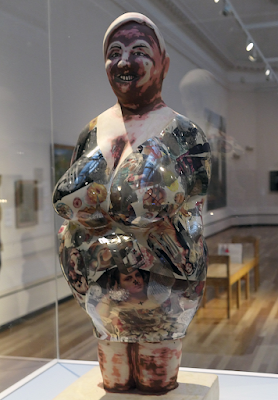
Grayson Perry, Melanie, 2014

Having responsibility for an art gallery is something of a challenge these days. When I visit a gallery with a permanent collection, such as York, I imagine the curators having sleepless nights about how to present it. Outside, the world is shouting (quite rightly) for equal rights, sexual equality, political justice, much which seem to be diametrically opposed to many of the works in the collection. Like most galleries, York has plenty of old paintings: a Saint Sebastian with arrows through him, a St Barbara being whipped, a male model strung up with cords, and so on – not the kind of images you would want to present without some explanation. How does a gallery deal with this challenge?

York Art Gallery’s response is quite dramatic. The main gallery is largely handed to members of the York LGBT community, who appear to have chosen the paintings displayed and added captions to them. A second room devoted to paintings is entitled “Treasures from the Stores”, although it includes some of the best-known pictures from the collection. Finally, a couple of big rooms are allocated to the ceramics collection, a highlight of the collection. 


When it comes to ceramics, you feel the curators breathe a sigh of relief. I didn’t see any pots with arrows stuck in them, and you would think that for the most part ceramics are sufficiently abstract for them to cause no offence. There was a quiet, contemplative feel about the ceramics galleries that is welcome; one wall, the Wall of Women, was dedicated to female artists. The almost homely feel was greatly helped by the lovely display of the Anthony Shaw collection, over 1,000 pieces, displayed in what feels like a domestic environment, with rugs, a fireplace and mantelpiece. The individual works are not captioned, although with a bit of detective work you can find out who did what. Overall, there is a warm feeling to the space. 

York Art Gallery is distinctive for its collection of contemporary ceramics, which, they say, is unequalled in the UK. It’s certainly one of the most imaginative presentations, something like Kettle’s Yard for porcelain. 

As for the paintings, you feel the gallery curators are almost embarrassed by their collection. As a gesture, they invited local gay people to select paintings from the collection and to add their comments alongside. 

Many of the captions seem to be determined to read things into the picture that do not seem warranted by the work itself. For example, one gay commentator claims that Anna Hudson’s The Visitor “is representing her own reality as a queer individual … the figure’s obscured facial features suggest a struggle with identity”. Well, it may be, but Sickert, Hudson’s contemporary, painted many figures with obscured faces, and we don’t immediately jump to similar conclusions about them. 


My final example of imaginative over-readings of a painting things is Composition, by John Banting. This work is a kind of still-life: a depiction of a classical bearded head (stated to be Greek in the caption, but could equally be Roman), a couple of mussel shells, plus a blackboard with an upturned squiggle. Out of this the commentator suggests “Does Banting long for Greece and its queer, starlit beaches?” Difficult to imagine, from the work in front of us. 

Of course, the main thing is that galleries are visited. There was a healthy number of people visiting the gallery on the Saturday afternoon when we were there, and they represented a wide range of ages – both a good sign. There was a tiny but inviting café, and a shop selling very interesting ceramics. All in all, a satisfying experience. Even though I never worked out why the medieval painter should focus on St Barbara was being whipped, I did enjoy Grayson Perry’s Melanie: a lovely, rounded figure, full of joie de vivre. 

Sunday, 3 March 2024

Do we care what William Blake means?


Blake, Newton (1795) (Tate)

What are we to make of William Blake? The author of some of the most famous lines of English poetry; the creator of some of the best-known images in art (Newton, Glad Day). Yet his work seems to many like a locked chest of mystical texts full of cryptic allusions, which literary specialists attempt laboriously to elucidate and to decipher (Northrop Frye spent ten years writing his 462-page book on William Blake, and his book is still regarded as one of the essential books on the artist and poet).

Do we all need to spend years trying to make sense of Blake’s visions? The current exhibition at the Fitzwilliam, Blake’s Universe (2024), tries to present Blake in his contemporary setting. The curators make it clear that they struggle to understand much of his writing and allusions, so they are by no means full Blake believers. Their approach seems to be as follows.

Blake, for them, was just one of many European artists and thinkers who saw history in chiliastic terms, and who attempted to reconcile (or to reintroduce) Christianity with history, often in a mystical fashion. Blake might have been mad, in other words, but so were plenty of others around the time of the French Revolution.

The problems start with the best-known images: what do they mean? For me, and perhaps for many other contemporary viewers, Blake’s art at its best conveys a dynamism and power that are unique for the art of his day. His Newton (1795), not in the exhibition, is an example: it is the basis of the popular image of the scientist. For me, there is something wonderfully vital and alive in the image of Newton carrying out his scientific experiments. Yet for Blake, this image of Newton represented, according to the introduction to the catalogue by Esther Chadwick, “a narrow concern with … ‘Vegetative and Generative Nature’ (the material world) … as opposed to imaginative inner vision (connected with faith in Christ, ‘regeneration’, and eternal life”). That sounds pretty negative to me. Presumably Blake wanted us to condemn Newton; yet Eduardo Paolozzi, creating a work of public art at the entrance to the British Library, replicates Blake’s figure, but now as a sculpture celebrating the way Newton changed the way we see the world. 

Eduardo Paolozzi, Newton (1995) British Library, London

When I look at this work, I don’t believe we are expected to condemn Newton every time we enter the British Library, but to feel somewhat in awe of him. I don’t imagine the Newton Institute for Mathematical Sciences, at the University of Cambridge, were delivering a rebuke to Newton for his narrow attitudes when they accepted Paolozzi’s donation of the model for his sculpture. I can think of few examples of an artist’s meaning being diametrically reversed in this way.

This switch from negative to positive is, I think, rather telling. At this exhibition, I looked at the famous images by Blake, yet as far as I could see, I may well have been reading Blake, like Paolozzi, in the opposite way to that intended. The images are powerful and attention-grabbing, but what exactly do they mean? Do we know what they mean, and are we bothered when they turn out to mean something very different to what we think they signify?

Blake, Europe: a Prophecy, Frontispiece (1794)

One of the other most famous images by Blake, the frontispiece to his Prophecy Europe, seems to be similarly misinterpreted. Again, there is a pair of dividers. According to the curators “Urizen [Blake’s name for the Creator] is seen with a pair of dividers, his head beneath the line of his shoulders, emphasising his cramped, inward-looking materialistic vision.”

For me, this image represents one of the most successful responses to the  challenge of how to express creativity, an almost impossible task for artists to convey. I think it is a thrilling image. I’d like to ask visitors to the exhibition what they think of it, and if they agree with the curators’ view (and with Blake’s view). Do we like Blake for the pictures, without worrying too much about what he meant? Perhaps, if this is true, Blake can take his rightful place in a museum of art, which is, after all, a collection of great images celebrating outmoded ideas no longer taken seriously. 


Saturday, 10 February 2024

The Cromwell Museum, Huntingdon


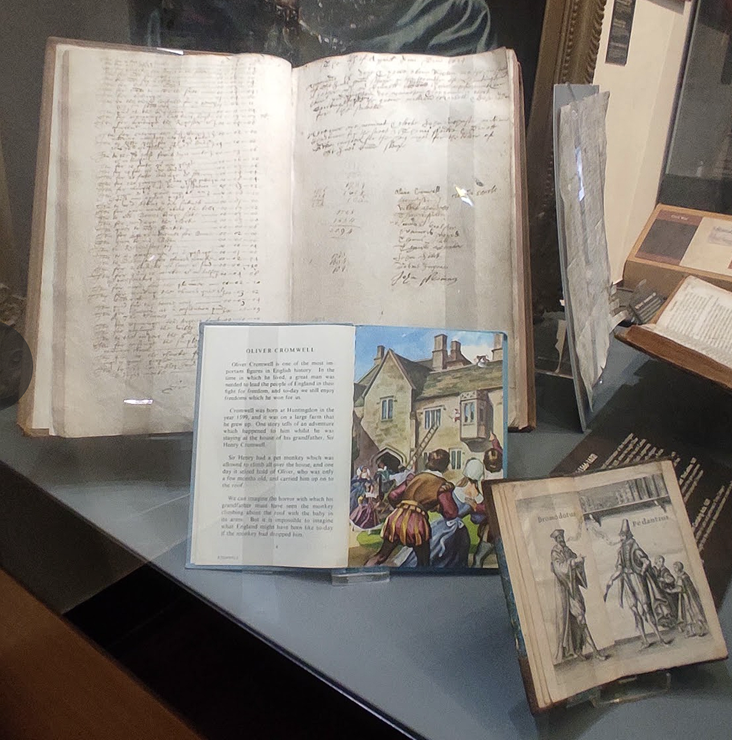
Not many museums include the Ladybird book on the subject alongside primary sources

This museum was a revelation: a great topic, fascinating and informative displays, interested and chatty staff, and the museum packed with visitors. I’ve been to many small museums in the past few years, and they are usually silent, well-meaning, but out of date. This one is a glorious exception. 

You would think that Cromwell is a sufficiently interesting topic, controversial even today, for any museum, but a contrast with the Cromwell House in Ely is very revealing. The Cromwell House is kitted out as a 17th-century domestic house, but contains nothing of relevance to Cromwell himself. As the staff in Huntingdon described it, they’ve got the building, but we’ve got the stuff. And so they do! Just one room, but packed full of items belonging to, written by, or associated with Oliver Cromwell. And not just meaningless memorabilia, for the most part.  Each of the bays shows a different part of Cromwell’s life, with the first bay showing a Ladybird book from 1963 about Cromwell, and the final bay showing his influence, including a model of the British Railways steam engine, the Oliver Cromwell, built 1951 (at which time it was clearly acceptable to name an engine after this controversial figure) and the title page of Carlyle’s Speeches of Oliver Cromwell’s Letters and Speeches (1845). 

Like many major figures, Oliver Cromwell means different things to different generations. I was fascinated not only by the way public opinion seems to have shifted from revulsion (after his death in the 17th century) to rehabilitation (from Carlyle and others) leading to his statue being placed in Parliament Square, where it remains today. For much of the 20th century he was a hero, if the Ladybird book (by I du Garde Peach, 1963) is anything to go by. The Ladybird book, ostensibly for children, begins: 

Oliver Cromwell was one of the most important figures in English history. In the time in which he lived, a great man was needed to lead the people of England in their fight for freedom and to-day we still enjoy freedoms which we won for us. [p4]

I'm not sure how many children would grasp this idea of freedom, and it's probably not how we would describe him today, and certainly not how the Irish would describe him, I would imagine. In academic circles, Christopher Hill represented the orthodoxy in the seventies and eighties, but today revisionist scholars such as Ronald Hutton seem to be in the forefront.


As for parallels with other despots, Cromwell appears to be more on a par with Lenin than with Putin, in that he at least started from a principled and justifiable position, even if he could not justify all his actions, whereas typical dictators act from self-preservation and appealing to the worst instincts of the populace.


Valiantly, the museum attempted to cover the historiography as well as the objects (paintings, hats, letters). In addition, the museum included a timeline of Cromwell’s life and contemporary affairs, several information boards, question-and-answer panels (“Did Cromwell abolish Christmas?”), together with the usual dressing-up items of armour and clothing for children, plus Cromwell tea towels and fridge magnets, and even ended with an illuminated quiz so you could compare your view of Cromwell before and after visiting the exhibition. 

Finally, as if that wasn’t enough, the museum had free admission (compared to £6.50 for standard admission to the Cromwell House in Ely), and stated it receives no government support. It sets a standard for other museums to try to match. There will never be agreement about a figure as divisive as Cromwell, but that’s no bad thing. On leaving the museum, there were campaigners in the market calling for an end to immigration and to “ideological teaching” in schools. I can’t help feeling that a museum like the Cromwell Museum generates reasoned discussion rather than mindless ranting. When I got home and showed my Cromwell quotations tea towel there was general derision in the household; but you don’t have to agree with everything he said to take him seriously.