Monday, 5 September 2022

Kenneth Clark, Landscape into Art (1949)


Durer, The large piece of turf, 1503

Re-reading a classic book from many years ago is always a challenging business. Scholarship has moved on, the world is a different place, we are not the same people we were when we first read the book. Landscape into Art was a book I greatly enjoyed when, aged around 20, I first read it. It didn’t feel like a work of scholarship, but a personal, heart-felt response to paintings the author loved – he was certainly unstinting with praise or condemnation towards the artists he describes. Most importantly, he asked the fundamental question: why landscape?  

Perhaps it is not surprising that, rereading the book many years later, the impression I have is rather different. Today I find the book unbalanced, missing lots of key examples, and with the wrong emphasis.

The book originated as a series of lectures. Perhaps this format lends itself to bold assertions. Certainly, Clark puts his finger on it from the first page of the introduction: ““Landscape painting was the chief artistic creation of the nineteenth century”.  More than that, he goes on to state “landscape painting has by now become the dominant art”.

So far, so good; but there are a lot of paintings discussed in the book which are not, in my opinion, landscapes. I understand “landscape painting” to be a new genre from the 19th-century, the representational depiction of the natural environment as a subject in its own right. Clark, rather oddly, only defines his terms in the epilogue to the book. By “nature”, he means “that part of the world not created by man, which we can see with our unaided senses”. In other words, the depiction of nature includes trees, water, sea, but not, primarily, buildings. I assume by “nature” Clark does not mean “people”, although the book describes many works that are primarily about people – more than half of the book discusses religious works, or paintings primarily about people.

Clark divides precursors of landscape art into four types, but the link between them and what I call the naturalistic tradition is perhaps greater than Clark imagines. These precursors, taking up four of the book’s seven chapters, are:

Ch 1 The landscape of symbols (medieval art)

Ch 2 Landscape of Fact (Van Eyck, Breughel, C17 Dutch landscape)

Ch 3 Landscape of Fantasy (Grunewald, Altdorfer)

Ch 4 Ideal Landscape (Giorgione, Claude, Poussin, Palmer)

One of these chapters, the Landscape of Fantasy, is by Clark’s definition not about nature. Much of the landscape of symbolism I find to be more about the symbol than about representation. 

John White Abbott, View near Canonteign, Devon, 1803

All of this is simply leading up to what he calls “the naturalistic tradition” in chapter five. Here, Clark describes the naturalistic tradition as an achievement of the C19, but surely there were painters creating works like this well before, back in the C18, and earlier. I don’t mean ideal art, like Claude, or Richard Wilson, but painters on a smaller scale, and often in watercolour. There are, of course, many nature studies by Durer, from around 1500, but then there are many eighteenth-century landscape studies in the English watercolour tradition, such as Alexander Cozens (mentioned briefly here, but not illustrated), John Robert Cozens (died 1797), Paul Sandby (died 1809), Thomas Jones (died 1803), William Pars (died 1782), and many others. Even where Clark mentions major schools of landscape painters, he doesn’t seem to follow his own guidelines. Perhaps the real reason why Clark gave these painters so little appreciation is that for many years they were seen as somehow subsidiary to the great painters in oil (or tempera). The greatest artists were Michelangelo and Leonardo, and landscape hardly counted in the High Renaissance. Incidentally, all the illustrations for this post use pictures that were not mentioned by Clark. 

As we read the book, we see some further criteria that Clark uses to value art. Meindert Hobbema is dismissed as “tedious” because “the elaborately described trees in his woodland scenes are not subordinated to a general principle of light (chapter 2)”. So light is the key, not trees or plants. More than that, the painting of light has to be “an act of love” rather than a trick (a term that dismisses all landscape painting from the end of the 17th-century until Constable or Turner). Moreover, landscape painting has to be sincere, not as in the works of Guardi, “the world of artifice” (unlike, strangely, Canaletto). The correct attitude to nature, in Clark’s view, is Wordsworthian … “the final stage in the development of man’s relations with nature” [p89]. Wordsworthian art is more than simply happiness. Clark on the Impressionists: “Impressionism was the painting of happiness … the impressionists were thereby cut off from the deepest intuitions of the human spirit” [p110]. Wordsworthian art is more a matter of love: ““van Eyck … Bellini … Claude … show us that the representation of light owes its aesthetic value to the fact that it is an expression of love.” [Epilogue]

John Crome, Landscape with cottages, nd

So true landscape art must be an expression of love, an “act of faith … and in the early C19, faith in nature became a form of religion”. This is essentially a Ruskinian point of view; in this respect, Clark is firmly with the 19th-century, rather than reaching forwards to the present day.

Clark’s stated criteria enables him to pick his winners and losers. His heroes are Hubert van Eyck, Brueghel, Giovanni Bellini, Claude, Turner. Artists who fail Clark’s test include Annibale Carracci (“of interest only to historians”), Hobbema (as mentioned), and Domenichino.

The greatest of Clark’s heroes is Bellini: “Bellini’s landscapes are the supreme instance of facts transfigured through love”, and yet the paintings he is referring to are Resurrections and Madonnas. Magnificent though these pictures are, I wouldn’t describe them as landscapes, despite Clark’s claims that they show Bellini’s local scenery.

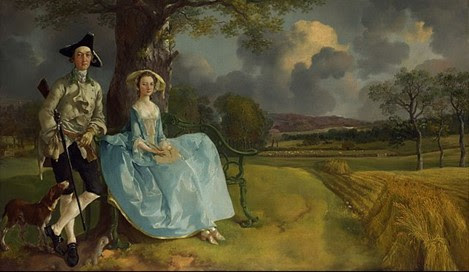
A common criticism of Clark today is that he has an elitist view. Not only does he not notice (as John Berger points out) that Mr and Mrs Andrews are busy owning the field that seems to Clark such a wonderful piece of landscape depiction, but Clark seems oblivious of the class- (or religion-) based implications of many of the works he describes.

In contrast, if Clark had chosen, he could have pointed out that the nature studies of the English watercolour painters, and the landscapes of Corot, are not exclusive; they represent places that are open for anyone to see. In that sense, Ruskin is more of a democrat than Clark.

Other oddities of Clark’s style are an alarming habit of stating with certitude something that cannot be verified, or which simply don’t make much sense:

  • “It is generally true that all changes or expansions of popular taste have their origins in the vision of some great artist or group of artists, which … always unconsciously, is accepted by the uninterested man.” [p86]
  • Constable …”recognized the fundamental truth that art must be  based on a single dominating idea, and that the test of an artist is his ability to carry this idea through, to enrich it, to expand it, but never to lose sight of it, and never to include any incidents, however seductive in themselves, which are not ultimately subordinate to the first main conception.” [p88]

Often, these tendentious statements are combined with assertions about England, usually to the disparagement of France:

  • [On Poussin] “The idea that an appreciation of nature can be combined with a desire for intellectual order has never been acceptable in England.” [p82]
  • [John Robert Cozens’] work belonged to that kind of painted poetry which the French find trivial.” [p139]

Is Landscape into Art worth reading today? When I first read it, I loved it, but today, I’m not so sure. Perhaps I would start with Ruskin, and then jump to more modern writing. 


Tuesday, 30 August 2022

Landscape painting: a new genre


Simon Denis, Trees in front of a Valley

When you visit an art gallery, you notice that most of the works inside fall into certain predictable categories. There are usually paintings of Christianity, such as Virgins with child. There are portraits. If it is a modern  collection, there are abstract and conceptual works, such as arrangements of rocks, or video installations. Sometimes, there are flower paintings (the Ashmolean had an entire room full of them). And there are landscape paintings.

You can divide landscapes into those that include people, and those that have no people at all. It’s the latter type, the landscape paintings without people, that interest me here. 

Special exhibitions at galleries are as predictable as the permanent collections. Two exhibitions about landscapes, one at The Tate Liverpool, “Radical Landscapes”, and the other at the Fitzwilliam, Cambridge, “True to Nature”, both contain predictable content, within each collection, yet they seem to be diametrically opposed to each other. It is difficult to imagine images from one exhibition appearing in the other.

As Kenneth Clark pointed out in his Landscape into Art (1947), drawing on Ruskin in Modern Painters, landscape painting, the depiction of nature with no or minimal human presence, has not existed for all time. It was largely a creation of the 19th century, and it is more of an innovation than you might at first imagine. What Ruskin is describing can be seen from a picture of trees by Simon Denis (1755-1813), displayed in the Fitzwilliam exhibition.

Radical Landscapes has, as its name suggests, a very different take on nature. The “radical” here asks questions about who owns, and who has access to, the landscape. Among the many exhibits (I admit I haven’t yet seen the exhibition) the following appear to be typical. There are banners from the women’s peace camp at Greenham Common. 

Presumably the thinking here is recapturing the landscape from being used to build nuclear weapons: this is very much humans in the landscape. Plus, a video of Romany heritage artist Delaine Le Bas in woodland surroundings, wearing a lovely dress; again, the subject is humans (one human) in the landscape. 


Finally, conceptual artist Gustav Metzger’s Till we have built Jerusalem in England’s green and pleasant land (1998) shows an ironic celebration, with a caterpillar track framing a photograph of the construction of the M3 motorway.

 'Til we have built Jerusalem in England’s green and pleasant land (Gustav Metzger, WikiArt)

It’s quite clear we are dealing with two different views of nature. The Liverpool show seems to have taken its starting point from John Berger’s famous critique of Gainsborough’s Mr and Mrs Andrews:

Gainsborough, Mr and Mrs Andrews, 1750

Berger states (in Ways of Seeing) that this image is more about who owns the field than details of the landscape. Now, Berger was responding to Kenneth Clark, who described the landscape in glowing terms but without mentioning the people. However, the Radical Landscapes exhibition seems to focus on the people and human activity rather than on the landscape.

We seem to have moved beyond the contemplation of nature identified by Ruskin. After describing what the human took an interest in during classical and medieval periods, Ruskin continues in Modern Painters with the rise of landscape as a form in its own right:

 [The human] used to take no interest in anything but what immediately concerned himself. Now, he has deep interest in the abstract nature of things, inquires as eagerly into the laws which regulate the economy of the material world, as into those of his own being, and manifests a passionate admiration of inanimate objects, closely resembling, in its elevation and tenderness, the affection which he bears to those living souls with which he is brought into the nearest fellowship.

Ruskin, Modern Painters, vol 3, Chapter IX, Of the Novelty of Landscape

That new ‘deep interest’ is what Truth to Nature, to a large extent, celebrates, whereas in Radical Landscapes, the deep interest appears almost incidental.   

I think Berger is right when he points out how fundamentally different art becomes when it includes or excludes people. To take another example from Clark’s Landscape into Art, if Berger complained that Gainsborough’s Mr and Mrs Andrews showed a couple owning a field, then what is the relationship between Virgil and the labourers in Simone Martini’s famous Frontispiece to Petrarch’s copy of Virgil?


Simone Martini, Petrarch's Virgil, titlepiece, c 1336

Virgil, with pen poised, is inspired to write, while the labourers (presumably his labourers) tend the vines (the Eclogues) or look after the sheep (the Georgics). I can’t deny, it doesn’t look like a vision of pure nature to me; in light of the above, it looks like Virgil owning the labour and enjoying the fruits.

By all means let’s look at ownership and access, but let’s have a genre of landscape art without people. It need not be connected with ownership or with activism; it shows something worthy of celebration in its own right. It doesn’t need to show only the picturesque; Richard Mabey’s book Weeds suggests there can be just as much value in what is not regarded as beautiful. But Ruskin covered this angle as well: he stated quite clearly, it is not simply the conventionally beautiful that is a legitimate subject for landscape art. It is perfectly valid to depict “road-side weeds, old cottages, broken stones, and such other materials”.

For this genre, the title is of little importance; perhaps the location, if anything. Even the slightest text has an influence: sometimes an image of a place can appear very differently once you have read the caption. For example, the website Common Dreams shows many images of natural beauty that have been impaired by human activity, for example the slurry from coal mining. However, if I didn’t mention the coal slurry, you might just have seen this picture as a muddy stream in winter (not in either exhibition):

Coal Slurry in West Virginia (Common Dreams, CC BY-NC-ND 3.0)

Which leaves us with, perhaps, a paradoxical conclusion. So much of the landscape is human-created, yet we have a fascination with, and indeed a love for, non-human nature. That is worth an exhibition in itself – and that is what, for the most part, the Fitzwilliam show celebrates. Ruskin continually surprises us by his observations of unplanned nature; here is a example by another artist, Carl Gotzloff’s Limestone Rocks, 1858: 


In its way, this is just as radical as anything in the Tate Liverpool exhibition.

Friday, 26 August 2022

Raphael’s place in the Pantheon of art history


Detail from The School of Athens

Is Raphael still top of the painting charts? Back in 1961, when art history was much more judgemental than it is today, Stephen Freedberg wrote a highly-regarded book that described the High Renaissance classical era (note the lower-case “c”). This lasted, according to him, between 1500 and 1520; just 20 years, comprising the great works of Leonardo, Michelangelo, and Raphael, and ending with the death of Raphael at only 37. It took Freedberg two volumes to describe that short period. Scholars argue over the precise dates of this classical moment, of course, but for many, and certainly for Wikipedia today, there appears to be general agreement that this period was “the absolute zenith of Western painting”. The Wikipedia article for High Renaissance defines it as “a short period of the most exceptional artistic production in the Italian States and in Florence”.

Even more astonishing is that Raphael appears to have burst onto the scene with his mature style almost already formed. “[in 1504] young Raphael, then aged twenty-one, arrived in Florence. He was already the possessor of a formulated High Renaissance classical style, of which the first evidence had been in his very earliest works” [catalogue, p60]. Moreover, we cannot explain just how Raphael acquired this style: “no outward occasion can account for the act by which Raphael infuses a transforming life into the shell of early classical détente.” [Freedberg again].

So any exhibition devoted to Raphael, such as that at the London National Gallery in 2022, would, I would have thought, have tackled that reputation. Is he really still the tops? He started painting the Stanza della Segnatura, including The School of Rome, in 1508, when he was just 25. Even Picasso, widely considered to be one of the most precocious painters of all time, only painted Les Demoiselles when he was 26.

The catalogue seems to take the precocity for granted (a study for the head of St James, dated around 1502, is as good as anything Raphael did), but it does briefly look at Raphael’s amazing mature reputation. Matthias Wivel writes (p46) “By the nineteenth century, Raphael was considered the pre-eminent visual artist of the Western tradition … until the advent of photography he was probably the most reproduced and copied artist in the Western world.” That seems to tally with my experience of visiting heritage sites: no 19th century interior is complete without a Raphael print, usually faded.

Marcantonio Raimondi, after Raphael, Massacre of the Innocents

Wivel then attempts to identify Raphael’s influence on Picasso’s Guernica. I could not imagine a painting more diametrically opposed to the coolness, the sophistication, the assuredness, of The School of Athens. Nonetheless, I can’t deny that the work we only know from engravings, The Massacre of the Innocents, shows a very different kind of Raphael: the most remarkable combination of elegant male forms and a sense of horror. And the late Transfiguration, painted just before Raphael died, does include a boy being healed as he has a seizure. It’s not all milk and honey.

Of course, there will never be full agreement among the critics. Some still believe that Raphael was the summit of Renaissance painting, and of western art. Others, such as the 19th-century pre-Raphaelites and Ruskin, felt his was already an over-ripe development beyond the “purity” of the early Renaissance. If you asked a class of fine art students today, they would probably ask you who Raphael was. He certainly wouldn’t appear in the top ten, or even top 20 artists.

We can discount the usual wacky ideas about Raphael from the critics, for example, Vasari believed these pictures were especially touching because Raphael was breast-fed by his mother, not by a wet-nurse. But even modern-day scholars have their wild moments. Ernest Gombrich believed that Raphael’s fondness for Virgin and Child groupings was a longing to recreate his closeness to his mother and father, who died when he was eight and eleven respectively. And there are modern scholarly articles on Raphael and breast-feeding, claiming that the infant in the Madonna della Sedia is drunk on his mother’s milk (doesn’t look like it to me).

Raphael, St Catherine, detail

Was Raphael the painter of ideal female beauty? The catalogue closes with a full-page close-up of the face of Saint Catherine of Alexandria, which could be seen (especially in close-up like this) as a kind of perfection, the platonic ideal (“una certa idea”) of female beauty. It certainly goes beyond the sentimentality of Raphael’s early master Perugino. But is it where we want to be today? To devote a whole page to a close-up of one face would suggest that the catalogue compilers still believe the perfect female face exists.


Tuesday, 23 August 2022

The Spalding Gentlemen's Society

Advert for the display of a "Little Wild Man"

The Spalding Gentlemen’s Society (SGS) made us very welcome, the Sunday we visited. It was the opening day of the first new exhibition for 20 years, and we were even invited (although we weren’t members) to the members’ only talk to present the new exhibition, entitled “Curious Collections”.

The curator explained that the exhibition comprised a personal selection by six people of items from the collection that they found interesting. I can’t fault the sincerity of everyone involved, but to be honest, “curious” seems the best way to describe it. There seemed to be no common theme running through the exhibition. It included some 18th-century maps, a depiction of a rhinoceros, which many people described as a unicorn, never having seen a rhino before, plus a poster advertising the public display of an Inuit (described as “a little wild man” ).

This exhibition, in a way, summed up the SGS. It seems to be the victim of its original collection. Like the Tradescant Collection that formed the basis of the Ashmolean Museum in Oxford, the SGS started as a coffee house discussion group, but soon became a collection of oddities – unusual, exceptional, sometimes (but not often) beautiful objects, donated by members, but without any coherence. However, over the years, the Tradescant Collection became a museum, with a collection policy and public role. It doesn’t look as though SGS, in its 300-year history, has ever got beyond the cabinet of curiosities.

Arranged over three or four rooms, the collection comprises many glass cases of the most amazing miscellany. Objects displayed include guns, china, prehistoric flints and axe heads, ivory carvings, playing cards, carvings by French prisoners during the Napoleonic wars, a few local items, a few items from all over the place. Some of the axe heads were found near Detroit. Largely run by volunteers, the SGS exhibits this hotchpotch in a glorious medley.

That “wild man” exhibit worries me. The poster describes how the Inuit was displayed daily to the public at an inn near Charing Cross, no doubt with admission on payment of a fee. You could pay to see the inmates at Bedlam, I believe, if you were interested. Exactly what has changed since the original display? Where was the discussion of how we no longer feel it appropriate to display what we think to be oddities of this kind? Is the SGS just the perpetuation of the cabinet of curiosities for the 21st century? YouTube and social media seem to have reinstated the cabinet of curiosities: you can see any number of questionable things on YouTube, but nobody claims they are educational. They are just there to be gawped at; which is what we appear to be invited to do with this poor Inuit man in a glass case in Spalding. 

 A quick read of a 2019 Society publication, Against the Odds: The Survival of the SGS suggested some of the claims about the society are less than accurate.

  • “The oldest provincial society with a continuous record in Britain” – yet the guide reveals there are no records for 1713-1724, 1758-1828, and 1875-1889: a total of 95 years without records.
  • The Wikipedia article for the SGS states that notables such as Newton, Alexander Pope, and Hans Sloane were members. I’m not sure if there is any evidence that they ever attended any meetings. They appear to have been honorary members, invited from afar. At least Newton donated a few books; I’m not sure what the contribution of the other distinguished members was.

Visiting the Society museum (open for a grand total of 12 hours each month) is not simple. It only opens for two hours a week, on Wednesdays, plus two hours on the third Sunday of each month. There is no space to display most of the collection, and yet, just down the road, there is a magnificent listed building, Ayscoughee Hall, which holds the local museum – and they have plenty of space to display more stuff. You could probably fit all the displays from the SGS in the current Ayscoughee Hall building. 

A case of coloured stones. No caption, but the stones look nice. 

As it stands, SGS is a poor museum. It doesn’t even rank on Tripadvisor as a museum in Spalding – most people wouldn’t know it was there. Even when you enter the museum, you could hardly describe the experience as educational. A report by archivists suggested that the most valuable items in the SGS collections are its own records, so perhaps studying its own history rather than all history might be one way forward. And why was the introduction to the new exhibition only for members? 

Some changes have taken place. The Society got rid of its collection of stuffed birds in 1955, so clearly, it is possible for the Society to make tough decisions about what it collects. But time is short. Its current building is subsiding and not fit for purpose. The finances of the Society make it pretty clear it is not financially viable – it cannot afford to repair its own building, quite apart from doing anything meaningful with the collection. It should rethink its purpose entirely; it looks like the major changes over the last 50 years, such as the admission of women, have been the result of external agencies such as the Charities Commission, insisting that the Society brings itself more up to date.

The example of Wisbech Museum is interesting: the history reveals that Wisbech built a public museum in 1847 that brought together the holdings of the local Literary Society and Museum Society. The museum still exists today. Like the SGS, it is full of glass cases. But it is regularly open to the public, and currently in construction is an accessible entrance and café area. Some kind of merger of the SGS with the local museum looks like the best way forward, funded partly by external bodies, and partly by judicious sales of some of the collection. Otherwise, the Society risks (and I quote from the official guide) “being run very largely for the benefit of members, and not, as declared in 1955, for the benefit of the public”.

Tuesday, 2 August 2022

Up in the Air, and the meaning of work


The plot of Up in the Air (directed by  Joel Reitman, 2009) can be told in one sentence. A commercial traveller, Ryan Bingham (George Clooney) who spends his life on the road claims to be happy and has a non-committal fling with a fellow frequent traveller, Alex Goran (Vera Farmiga); when he decides in the middle of a speaking engagement to visit her home to declare his love, he discovers she is married with children – something she hadn’t mentioned. 

Put like that, it’s a minor-key romantic comedy that could have been directed by Douglas Sirk. But the film is considerably more than that, with three additional subplots that make the story far more complex. 

First, the movie presents us with a picture of family life that is by no means rosy. Bingham visits his sister for her wedding, and the event is mundane, the people uncharismatic, and the location uninspiring. Would you abandon the high-flying life for this? Worse, the groom gets cold feet, and Bingham, of all people, is enlisted to persuade him to go through with the wedding. 

Second, Clooney’s job is not just any job. His job is to fire people; we see a haunting series of cameos of people who have just been told they have been fired (the director got real-life people to talk about their experience, and these clips looks uncomfortably authentic). By a strange twist, Clooney himself is effectively fired later in the movie: he is told that his role has been replaced by online conference calls. The experience of being told he is superfluous has a dramatic effect on his earlier unshakeable confidence about his nomadic life. 

Third, Bingham is accompanied for much of the film by a young new employee, Natalie Keener, full of ideals and inexperience, who has all the romantic dreams that Clooney doesn’t have. 

Ryan Bingham: [on the docks in Miami] You know that moment when you look into somebody's eyes and you can feel them staring into your soul and the whole world goes quiet just for a second?

Natalie Keener: Yes.

Ryan Bingham: [shrugs] Right. Well, I don't. 

In other words, unlike most Hollywood plots, this is not a simple decision. But what makes it a great film is that Clooney misreads the signals; he gets it wrong. At the end of the film, he bet on his carefree partner being sufficiently keen on him to commit to living with him; he didn’t realise that she was, as she states to him quite openly, “the woman you don’t have to worry about … just think of my as yourself, only with a vagina”. 

How did we get here? A Hollywood feel-good comedy, starring George Clooney, with a magnificent, photogenic face, named by People magazine as the sexiest man alive, used by the Coen Brothers as a figure of fun in Burn after Reading and Hail, Caesar, suddenly becomes dark and confronts the world of work. Why do we work? What do we really value? What do we want to come home to? In the last few scenes, Bingham is awarded his coveted airline loyalty card, after flying ten million miles with them. But by the time he wins it, the award is meaningless. This is a remarkable, disturbing film that you continue to think about days after seeing it, all the more powerful for moving beyond the initial seemingly light-hearted introduction. It’s a performance worthy of Mastroianni at his best.


Sunday, 10 July 2022

Is Beccles the perfect small town?


Beccles from the River Waveney

What do you want from a town where you live? According to Lewis Mumford, cities should combine technology with cooperation and collaboration. Given that Mumford was writing in 1961, what he meant by “technology” was perhaps not as forbidding as it might sound today. I don’t think he was referring to high-speed broadband. 

So there we were, walking around Beccles, a medium-sized market town in Suffolk, with a population of around 14,000 That makes it around the tenth-largest town in Suffok (Ipswich is the largest, with 145,000). That makes it large enough to have several restaurants and cafes, as well as, intriguingly, an open-air lido (brought back to life by community initiative) and a locally owned pub (the Lock Inn, at Geldeston). 

So what makes a town alive? You can explore various criteria. Beccles has a lovely library, a haven of peace, and still open (and in use) at 5pm on a Friday.


Beccles has a great café, serving its own chocolate, and exceptional cakes, with an enclosed garden where robins bathe in the fountains. It has a delicatessen selling local cheese. It has both a new and a second-hand bookshop.  

Most importantly, people talk to you! Without exception, everyone in local shops started chatting. Even the local boat-owners on the quayside, as well as the man piloting the Big Dog Ferry along the Waveney, and the friendly volunteers staffing the (free) Beccles Museum. You couldn’t ask for more. There seemed to be a fair number of buses (an hourly service to Norwich and to Southwold), plus that rarity, a local railway station. OK, it only goes to Lowestoft or to Ipswich, but better than nothing.

Within 24 hours, we had been told where to buy plants, where to eat, where to stay, the state of local politics (seems like the Greens are very active), and what kinds of second-hand books sell (apparently, blind-date books, wrapped in brown paper, so you don't know what you are buying).

The town has a fascinating series of alleyways, called Scores, that lead down the hill to the water. Often the obscured view is better than the actual view.


Were there any downsides? Yes, the traffic. Like many small towns with a historic centre, the council has opted to make the small roads one way only. This has the unintended side-effect of making the traffic go faster, in the absence of any oncoming vehicles. So instead of the hoped-for tranquility, you get cars at 40mph in the centre – not a calming sensation. Doesn’t really encourage open-air street life. The view below, with S S Teulon’s solid and respectable three-storey Barclays Bank in the distance, is not typical.


Yet there is one wonderful street that is pedestrians only, outside the Kings Head hotel and pub. Although the tables and chairs are only for the pub, the effect, even though it is only a few yards long, is palpable. There was even a street musician playing for the entertainment of passers-by.


All in all, a fascinating town.

Sunday, 3 July 2022

Was Picasso a child genius?

Picasso, Woman Combing her hair, 1906

The recent exhibition at the Sainsbury Centre (Picasso: Legacy of Youth, July 2022) was both informative and fascinating. Focused around a handful of seven Picasso works owned by the Sainsbury Collection, the exhibition (and accompanying book) provides a context and examples from the work of some contemporaries to provide a rough idea of Picasso’s development, in particular his eclecticism – how he borrowed widely from others. Clearly, young Picasso seemed precociously talented – there is a life drawing executed when he was just 15, which is truly remarkable. 

Picasso, Academic Study, 1896 (when he was 15)

At the same time, his talent stretched well beyond simply becoming a member of one or other movement. With the exception of Cubism, Picasso seems to have played with components of any number of styles from his contemporaries and predecessors, including (in this exhibition) Gaugin, Monet, Goya, and Toulouse-Lautrec. 

The key question that the contributors to the catalogue wrestled with is that “legacy of youth”. Was Picasso was a child genius, or did his true talent only emerge as an adult? Picasso himself had some seemingly relevant statements on the subject, quoted in large type on the walls of the exhibition: 

“I have never done children’s drawings. Never. Even when I was very small.” [from Helen Parmelin, Picasso Dit, 1966]

This remark, even allowing for Picasso’s gift for stating quotable sayings, seems quite possible, if his father was pushing him through a conventional art training from a very young age. But some of the contributors to the catalogue are not content to leave things there. Paul Greenhalgh, the exhibition curator, describes this fallacy about great artists, that they somehow emerged from the cradle with all their creative talents ready for us. Vasari, in his Lives of the Great Painters, repeatedly retells this myth when describing Giotto, Raphael and Michelangelo. You would think that today we are beyond such mythmaking, and yet this catalogue contains several examples of just the same kind of thinking. 

The most likely explanation seems to be what the catalogue reveals, the slightly less incredible story behind Picasso’s apparently magical talent. His father was an art teacher of a very traditional kind, who trained his son from a very early age using standard techniques such as copying and life drawing (tantalisingly, the catalogue does not reveal further details of this training). The result, it appears to me, was that Picasso was able to work within the classical tradition or not, but crucially was able to choose either route. It wasn’t magic.  

The catalogue itself provides a justification for this view of early Picasso. William Rothenstein, who taught art at the Royal College for many years, stated: 

At the Royal College of Art I tried, by demonstration before the students, to hint at a logical method both of drawing and painting, only to find it consistently disregarded; yet for tennis, billiards or cricket, the advice of professionals is carefully followed … why should painters alone disdain discipline? [page 45]

This would appear to explain Picasso’s own statement that he never painted childish paintings, even when young. His father appears to have taught him “specific skills, mainly acquired through drawing from life” [Haigh, page 45]. Greenhalgh explains that statement as “he isn’t suggesting possession of early genius, but that he was encouraged from the start to work in a quasi-professional manner” [catalogue, page 58]. Somewhat like John Stuart Mill being taught as if he were an adult from before the age of five, and only much later discovering his own childhood. 

Here in the catalogue, however, we have authors contributing to the mythmaking. Here is John Onians on Picasso’s magical ability to learn from his father just by watching: 

just by watching his father go through the processes involved in art making, whether drawing or painting, mixing pigments or creating a composition, [Picasso] could , unconsciously, become equipped with some of the neural resources of a mature artist. [John Onians, page 38]

If this were true, artists’ models would be among the greatest artists of all time. Sadly, that does not appear to be the case.  

Onians makes other grand claims for Picasso, reinforcing the idea of painter-as-genius: 

Picasso was famous for the exceptional intensity of his looking: which means that , whatever the object of his concentration, that looking will have had a greater impact on his nervous system than it would in someone else.” [Onians, page 29] 

Clearly, the artist as superman. Moreover, Picasso was an artist uniquely tuned to recognizing bulls: 

For a start, Picasso would have possessed exceptionally rich neural resources for the perception of bulls, not only because his father often took him to bull fights as a child, but because he had himself studied them intensely [Onians, page 38] 

This reminds me of the time I worked in a cinema and was told by one of the customers that they were coming to see The Sound of Music for the 17th time. I should have checked his neural resources immediately. 

Perhaps I am being unfair to John Onians, but I have little patience for someone who has written a whole book about “neural art” and yet appears not to understand the meaning of the word:

Indirectly, Picasso himself have some responsibility for persuading me to write about art in neural terms. He … advocated an engagement with art that was not mental but visceral.  [catalogue, page 21]

I thought that neural meant “mental”, rather than visceral.

What did I think of the pictures? From looking at the Picasso works in this exhibition, I get the feeling that Picasso had a remarkable ability to emulate other artists, but also to stand back from the context in which they painted; he could work within their ideas, or parody them, as he chose. For example, the exhibition includes two nude drawings: Woman Combing her Hair (1906) and Academic Study, an early drawing from 1896, when Picasso was just 15. Paul Greenhalgh describes the Academic Study as moving away from earlier classical studies, yet ten years later, the Woman Combing her Hair looks to be a very classically-inspired image. The Academic Study does appear to be in the tradition of the end of the 19th century figure drawings, such as Pierre Vallette, teaching art in Manchester:

Pierre Vallette, Life Drawing, 1910-12 (Manchester) 

Greenhalgh describe the Academic Study in words that could equally be applied to the Vallette Life Drawing: “he is an ordinary man of his times, sporting a moustache … he is the polar opposite of the classical ideal”. [Greenhalgh, catalogue page 52]

My point is that Picasso from an early age was able to jump in or out of the classical tradition, but at the same time retain almost instinctively a classical way of working, so that even many of his most iconoclastic works turn out to have classical aspects to them.  The Demoiselles d’Avignon is, after all, not so far from the Three Graces.

One essay makes a good point here. Michael Cary talks about John Berger’s interpretation of Picasso in his Success and Failure of Picasso (1972). For Berger, Picasso’s facility at drawing and composition meant that he never got past the childhood repetition of his slick facility. Instead, claims Cary, following Elizabeth Cowling, Picasso “adopted the language / visual style of other painters to create original works of his own”. As an explanation for Picasso’s leap from emulation to originality, it is as good as I have heard.