Thursday, 8 July 2021

Jean Dubuffet at the Barbican (July 2021)

Exhibitions of Jean Dubuffet are, it seems, rare. This seems surprising given that Dubuffet offers what appears to be a genuine outsider, someone who did not form part of the mainstream of the artistic development of his time, but who nonetheless made significant statements through his art.

Most importantly is the idea of Art Brut: that so-called naïve art, lacking correct perspective and very close at times to caricature, can be a valid art form in its own right. Of course, it is common knowledge that Picasso and early 20th-century painters looked to early African art to give their paintings an immediacy that the official art of the day lacked. But Dubuffet takes it much further than that. Picasso, for all his modernism, retains throughout a reassuring classicism which makes the viewer feel comfortable: it’s not quite right, thinks the observer, but I can still see the talent of the line drawing and the composition.

With Dubuffet, you see the full “primitivism” of the image. Its not primitive, because Dubuffet knows exactly what he is doing, but it is still a shock to see the human body without any beautification (which is, after all, what most art has been doing since prehistoric times).

That rawness, observed from the art of the severely disturbed, has a haunting quality to it. It breaks the Western myth of the beautiful image. Not surprisingly, Dubuffet diverges from the tradition of painting beautiful images of women. His female figures are equally devoid of attractiveness, just a lump (or several lumps) of flesh presented bluntly to the viewer. 

Dubuffet’s art has a hit-or-miss quality, undoubtedly. It seems he would go off on the trail of an idea or theme and pursue it for some months with a passion, then change tack entirely. Some of these themes were covered in the Barbican Dubuffet exhibition, but it would appear there were several others as well – Dubuffet was amazingly prolific. But you forgive him the occasional lapse because of the compensation: an engagement with the immediate, the full force of the moment. Some of his best works, for me, were those done in the 1960s when he was depicting everyday reality on the Paris streets and in restaurants:


This is just a picture of people on a bus. But for some reason, the image of a crowded urban landscape is powerfully present. The painting is two-dimensional, so the pedestrians appear upside down at the top.

Most disturbing is the kind of manic smile, again, taken from children’s art and the art of the disturbed, that can be seen on the faces of the people on the bus. This fixed grin is a frightening reminder of the need to keep up appearances in the city. Don’t, whatever you do, give the impression that you are not enjoying yourself and in control.

If Dubuffet were to paint your portrait, you would not expect him to do a full likeness, but the painter, who it seems was very skilled at making controversial statements, said that his aim when portraying someone not to make any sketches from life, but to deliberately wait and then try to compose an effective portrait from memory of how that person appeared to them. Whatever the technique, the result is compelling: here is a drawing of Antonin Artaud: 


With paintings like these, who needs an art academy?

Sunday, 4 July 2021

Stefan Zweig and Joseph Roth in Ostend


Zweig and Roth in Ostend, 1936: a terrifying image of Joseph Roth

The idea of two famous Jewish writers meeting in exile in Ostend in 1936 as their world disappears around them is such a powerful image that the story could hardly fail to be fascinating, if desperate.

Yet Volker Weidermann, author of Summer before the Dark (2014) almost manages to mangle the story. Vague when he should be precise, and detailed when any reader would expect to have more evidence of where the information is obtained, he manages not to tell us what makes Zweig and Roth distinctive and leaves us guessing for more of the story to make it intelligible. It is a book with no index, no sources, no citations, no chapters. The translator appears to have added a few notes about some of the characters, but these notes are inadequate.

As for missing details, how about:

  • (page 21) “Belgium, that glorious country … that had heroically resisted all invaders over the centuries”. Since Belgium only became a nation state in 1830, that hardly seems an apt comment.
  • (page 68) “She travels to Brussels for the day. She’s been told she could get to know Hermann Kesten there.” Who is Kesten? we are told a little in the following pages, but it is typical of Weidermann’s style to introduce characters without any description, or even, at times, without any name.
  • (page 140) “From his homeland … It’s Festival time, as it is every year.” Which festival? Would you like to tell us? We guess half a page later, but why does the author play this guessing game with his readers?
  • Ostend figures loosely in the narrative, but two pages (92-94) are dedicated to a murder that took place there. An account was written by Hermann Kesten, but are we supposed to believe that Ostend is exceptional for murders? Or that the group of exiles took any interest in Ostend, apart from it being a conveniently neutral base?
  • (page 98) As for sexual politics, this is a book where the women are subservient, even to men who are drinking themselves to death. And, of course, young women are stunningly attractive:  “Wherever she goes with him, writers almost go crazy at the sight of her youth and beauty”.  This is a description of Christiane Grautoff, whom Roth met when she was 15.
  • (page 116) “Irmgard Keun loves Joseph Roth and sees into him more deeply than anyone ever has.” If this were romantic fiction, I wouldn’t question such a statement, but given Roth’s advanced alcoholism, it might perhaps be more accurate to say she is prepared to drink with him more than anyone else does – a rather different relationship.
  • (page 143) Zweig is preparing to travel to Argentina and he and his partner are learning Spanish. But on page 150 he arrives in Brazil, and spends the rest of his life there. It would be interesting to know how the switch occurred. On page 152 we learn he only planned to spend two weeks in Argentina. They don’t speak Spanish in Brazil. Am I the only one to be confused by this narrative?
Finally, it isn’t clear from this book why Zweig committed suicide, or even what happened to his wife Lotte. Weidermann writes that Zweig was received with adulation when he arrived in Brazil, and writes of Zweig’s “love for Brazil” (page 152). It’s a bit of a jump to committing joint suicide a few pages later. Here is literature reduced to Sunday newspaper journalism, sex, scandal and drinking, with little care if the pieces don’t all hang together. For me, the final straw was the quote from the FT on the cover of the English paperback edition, a club-footed and tasteless comment on what is after all the description of an alcoholic writer's decline and death:

"Death in Venice with more sex, more booze, more action". 


Wednesday, 30 June 2021

The Language of Modern Ethics


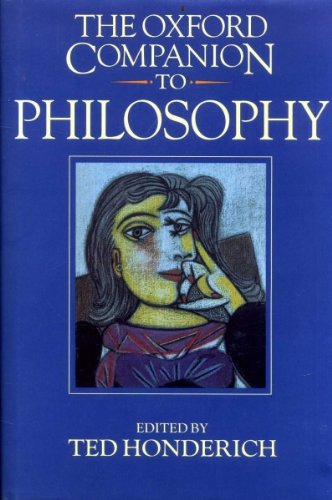
First edition of the Oxford Companion to Philosophy, illustrated by a Picasso painting of a thinking woman. Perhaps, it suggests, too much thinking distorts your features

A review by Julian Baggini is always worth reading, because he has the ability to make philosophy popular; or rather, to remain aware of everyday thinking alongside the sometimes strange paths that academic philosophers take.


So I turned with interest to a review article in the TLS where Baggini reviews several books on moral philosophy, and in the course of his review provides what appears to be a very useful summary of recent thinking in this area. Most helpfully, he describes many of the terms used in the current philosophical debate. So here is a mini-dictionary of current ethics. Out of interest, I have compared it with three titles published 25 or more years ago:

  • The Oxford Companion to Philosophy (edited by Ted Honderich), first edition, published 1995
  • A Dictionary of Philosophy, by A R Lacey, 1976
  • The Penguin Dictionary of Philosophy, edited by Thomas Mautner, 1996

What can you do with such knowledge? Well, if you are a geek like me, you can attempt to see the trends in a subject over time. You can see if these terms appear in Wikipedia. You can use Google n-grams to track increases or decreases in usage.

  • cognitivism – the claim that statements such as “murder is wrong” are either true or false.
  • consequentialism – the theory that actions are right or wrong to the extent that they result in good or bad consequences.
  • contractarianism – the theory that morality is an implicit acceptance of mutual obligations and prohibitions.
  • deontology – the view that morality concerns duties to follow rules or fulfil obligations.
  • incommensurability – theory that you cannot compare the value (say) of museums with the value of hospitals; or individualism versus community-based ethics.
  • metaethics – thestudy of the nature of morality itself
  • moral particularism – theory that there are no general rules that determine if actions are right or wrong.
  • moral relativism
  • moral sympathy - Enlightenment theory that we should recognized that others have lives worth living. Held by Hume and Adam Smith.
  • realism – in ethics, the claim that moral values have a real, mind-independent existence.
  • virtue ethics – theory that goodness resides in character and habit.

Leaving aside "moral sympathy", which Baggini states is from 18th-century writers, that leaves us with ten terms. 

term

Oxford (Honderich)

Lacey

Penguin (Mautner)

cognitivism

yes (actually under “non-cognitivism”

no

yes

consequentialism

yes

yes

yes

contractarianism

no

no

yes

deontology

yes

yes (under “ethics”)

yes

incommensurability

yes

no

yes

metaethics

yes

yes (under “ethics”)

yes

moral particularism

no

no

no

moral relativism

yes (under “ethical relativism”)

no

no

moral realism

yes

no

yes (under “realism”)

virtue ethics

yes (under “virtue”)

no

yes

Total

9

3

8

What does this tell us? The Lacey Dictionary of Philosophy is rubbish, perhaps, but to be fair, it is considerably shorter than the Penguin and Oxford volumes. You could say, perhaps, it was incommensurable, because it is the work of one author who clearly does not appear to be very interested in ethics. You can also see how maddening natural language is. Do we describe an idea under “relativism”, “moral relativism”, or “ethical relativism”?

One wonderful value of the Oxford Companion is a detailed index that lists all concepts, as well as all headwords. This makes it easier to find things in a print volume. You could probably say that nobody these days finds things in a print volume; but it is reassuring to think that behind the scenes, the compiler used a list like this inex to identify where entries would be located.

Perhaps the most interesting conclusion for me is how slowly philosophy evolves. If moral philosophy has become of interest to the public and to philosophers, after many years in the wilderness, it seems that not much has changed in the last 20 years.  Perhaps the key term is “moral particularism”. None of the older works includes this. Perhaps this is the great innovation in 21st-century ethical thinking. Or perhaps, if this is the only really new idea, not much changes in the world of ethics.


Sunday, 20 June 2021

Free trade and protectionism: the same old arguments


The Free Trade Hall, Manchester: built on land donated by Richard Cobden to celebrate the repeal of the Corn Laws in 1846. Today, the building is just a shell: the interior was gutted and replaced by a hotel between 1997 and 2004. It remains perhaps a symbol of the UK's attitude to free trade. [Image by Bernt Rostad, CC BY 2.0] 

Martin Wolf, the FT columnist whose writing is always worth reading, had an article this week under the strident heading “Spurn the false promise of protectionism” (FT 16 June 2021). 

I’m not suggesting I can write a definitive piece about protectionism in a few hundred words. But I can at least ask a few questions in response to some of the current opinion pieces.

The standard view of economists is pretty straightforward on this one: free trade is a good thing, and protectionism is bad. Here is Samuelson, the standard textbook on economics, 19th edition: 

Economists generally believe that free trade promotes a mutually beneficial division of labor among nations; free and open trade allows each nation to expand its production and consumption possibilities, raising the world’s living standard. (Samuelson and Nordhaus, Economics, 19th edition, 2010, p349) 

Martin Wolf largely endorses this view, bringing in the heavy guns of Anne Krueger and Adam Posen to justify his view. Wolf quotes Krueger as stating “trade has been the handmaid of economic growth, across the world, since the second world war.” And it is certainly true that the protectionism celebrated and endorsed by Trump has been continued by Biden – no reversal of policy there. 

But from my position as a innocent bystander, as it were, between the politicians, who see protectionism as politically expedient, and the economists, who are largely for free trade, is there any centre ground? 

Firstly, there are economist who disagree with the whole “comparative advantage” argument – that each state should stick to what they do well. That means that Colombia should stick to producing coffee, while the US sells it high-tech products. Ha-Joon Chang, for example, in his 23 Things they don’t tell you about Capitalism (2011), links protectionism with immigration policy – many manufacturing jobs in Europe and the US could be done much more cheaply if more immigration were allowed. His level of argument is considerably more sophisticated than the standard economics writers. It appears to me that not much has changed in most economists’ thinking since I was learning about economics in the 1990s.   

Secondly, there are whole areas of the economy where the continuance of protectionism is not questioned. When the UK left the EU, there was no question, once the Common Agricultural Policy was no longer mandatory, of abandoning subsidies to UK farmers. But why are farmers subsidised? It seems a reasonable enough question. And why is manufacturing subsidised, when it represents such a low proportion of GDP in a country such as the UK? There is no mention of agriculture by Wolf or by Posen (I haven’t yet checked in Krueger). 

Thirdly, I don’t believe the economists themselves are serious about ignoring the consequences of free trade in terms of closed factories, especially in deprived areas such as the North of England and states such as Ohio and Michigan in the US. Posen states, in the article praised by Wolf: 

there are precious few examples of a government successfully reviving a community suffering from industrial decline. Geography is not destiny, but it is the embodiment of economic history in many ways, and accumulated history is difficult to overcome. 

Yes, workers in a town with closed factories are largely white and male, but does that mean, as Posen seems to imply, there is nothing to be done? That regional policy is a waste? 

Finally, I thought that economic historians showed many years ago that free trade tends to be adopted by nations when it suits them. In the 19th century, Britain was only too happy to have free trade while its manufacturing costs were (briefly) lower than those of any other nation. It was a competition with only one winner. 

It seems to me that the economists and politicians argue past each other, without any real engagement. It doesn’t seem unreasonable to ask for a higher level of engagement between politics and economics. Articles such as this one by Wolf are unlikely to result in any policy change in the UK or the US – so why write them?


Tuesday, 8 June 2021

Imperial Mud: the story of Fenland resistance


Imperial Mud, by James Boyce (Icon, 2020)

When I saw this book, I felt it inevitable I would buy it. I was in Waterstone’s Bookshop, for the first time in many months, following the covid-19 lockdown. A book on the Fens, and a scholarly book at that, displayed strategically on the new titles table, seemed too good an opportunity to miss. Having just visited the Fens (see the post on Isleham a few weeks ago), I felt this must be a message from the gods. Or, perhaps, from the Fens themselves.

Even more surprising was the tone of the book. Boyce’s account is not a tale of triumphant engineers combatting the floods to bring civilization to a remote quarter of England. Instead, displayed alongside the memoirs of TV stars and personal growth titles, here is a genuinely radical history book. James Boyce’s thesis is that the Fens represented an area of protest against enclosure, over at least 400 years, and he skilfully links it to the English Civil War (Cromwell was born and grew up in the Fens) to industrialisation, the agricultural crisis during (and after) the Second World War, right up to the environmental movement of the present day. His suggestion is that people lived better (and certainly more equally) in the unenclosed Fens than in the surrounding counties.

Even more remarkably, Boyce shows how the Fennish (his term) did not fit in a simple left/right agenda. While the young Cromwell supported the Fennish in their protests against enclosure, he changed allegiance once in power and aligned himself with the landowners trying to carry out the enclosures. In this instance, the Fennish called on the king to protect their traditional rights. In other disputes, the Fennish battled against the king, who had made deals with local landowners as a partner in the land exploitation. It is not a simple story, in other words; although as a rule the local inhabitants suffered, since frequently the monarch was in partnership (even as an investor) with nobility.

I have a few reservations. James Boyce has written a hybrid, a popular book with pretensions to scholarly standards. But the result, as so often, fulfils neither criterion very well. The book has lots of footnotes, some of which carry useful additional information (so why wasn’t that incorporated in the body of the text)? More seriously, the book is written almost entirely from secondary sources, and some of those rather questionable (how about Maureen James, Cambridgeshire Folk Tales?). Overall, I forgive the author since he has written such a compelling account and has made it relevant.

My other reservation is that he fails to explain how a radical area, with centuries of experience of protest and demonstrations, has become so resolutely Tory. The Fens are the area of the UK with the highest number of uncontested seats in local elections (one-third of the seats in the 2019 election, according to Peterborough Today) – and all of those seats are Conservative.

Boyce describes initiatives to recreate some of the common land lost in the Fen enclosures, including one in Spalding. What makes Spalding such a centre of radicalism? To an outsider, visiting the Fens today, there seems very little sign of radicalism or of environmental concern. There are plenty of horses to be seen, but these are horses for entertainment, not for working.


Monday, 24 May 2021

Holiday (1938)


Katherine Hepburn and Cary Grant in Holiday

What could be better than a film directed by George Cukor and starring Cary Grant and Katherine Hepburn? Well, many other films, actually.

Holiday was a great disappointment. Since two of the three most important criteria for a great film were in place (good director, good actors), the weak point must be the script. Clearly, Holiday is a filmed version of a play; but there are plenty of great films that started life as a play (Arsenic and Old Lace is an example). Why the film was so poor constitutes an interesting case study. The biggest single reason is simply that the film wasn’t very funny.

The basic premise is simple. Johnny Case (Grant) meets Julia Seton (Doris Nolan), the elder daughter of a fabulously wealthy but dysfunctional family. He is presented to the father, who judges the potential son-in-law exclusively for business acumen and social eligibility. The scene where Grant is interviewed by the family father is indeed funny.

But compare this scene, or indeed any scene in Holiday, with The Awful Truth. The quality of the repartee between Grant and Irene Dunne is way beyond anything in this film.

The stiff family setting is contrasted with scenes in the play room, where the children grew up, and where the tone is much more relaxed. More relaxed, but not completely relaxed.

What is Johnny Case planning to do? The marriage is arranged and the father approves – until Case reveals he intends to stop working (albeit financed by his own savings), and to travel until he discovers – what, exactly? He says: 

Johnny Case: The world's changing out there. There are a lot of new, exciting ideas running around. Some may be right and some may be cockeyed but they're affecting all our lives. I want to know how I stand, where I fit in the picture, what it's all gonna mean to me. I can't find that out sitting behind some desk in an office, so as soon as I get enough money together, I'm going to knock off for a while.”

What exactly does that mean? The playwright had to be very careful not to suggest doing nothing (as that would give the wrong impression of this earnest young man, even though Case uses the word “holiday”), nor to suggest any kind of radicalism (what if he discovers Marxism? Or fascism?). He could discover philanthropy, which might provide some kind of justification for marrying into such wealth. 

In the end, Johnny Case runs off with Linda Seton, the younger sister, who is more bohemian than her sister, but no doubt equally rich. If Grant is seeking wisdom, as Linda points out, the family he is marrying into has enough money for ten working lives, so he can spend the rest of his life searching for wisdom at his leisure. In any case, what has Linda Seton been doing living at home all the time, with a family she finds so distasteful? Waiting for Mr Right to appear? Does she have nothing better to do? Apart from meeting Grant, her only achievement in the film is to refuse to appear at her sister's engagement party. That's not so funny. 

Other examples of funniness that fall flat are a couple who are friends of Grant, Professor Potter (Edward Everett Horton) and his wife Susan (Jean Dixon). But their wordplay is trite and Grant hardly shines with them. Nor, I am afraid, does Hepburn.

In the end, Case sets off on his journey to find new and exciting ideas, by going on a cruise liner. I don’t think he is likely to find many ideas there.


Tuesday, 18 May 2021

Drive your plow over the bones of the dead


Blake, Proverbs of Hell

Here is a remarkable novel, by Olga Tokarczuk. Part murder mystery, part description of life in a remote Polish village near the Czech border, it defies your comfortable assumptions and keeps you guessing until the end. But it's not just about who did it. 

The title, and quotations at the start of each chapter, are from Blake, and this is one of several strands artfully pulled together by the novelist to create a very satisfying combination: a good narrative (you want to know what happens next), a remarkable narrator, and a cast of oddballs. This is one of those novels where everyone is slightly strange, none more so than the narrator herself. The narrator, an elderly woman, is keen on astrology and animal rights, as well as having a very idiosyncratic and opinionated view on most things: for example, she dreams up nicknames for each of the other characters (“Big Foot”, “Good News”, “Oddball”). As a reader, you are unsure of her pronouncements, which are a combination of well-argued and totally wacky; sometimes both at the same time. The strange, tense atmosphere of the book is reflected in the use of capital letters for many, but not all, of the nouns, reflecting what is presumably the narrator’s odd sense of priorities in the original Polish. As the narrator points out with delight, single old women are not noticed any more in literature than they are in real life, which is justification alone for reading the book.

The narrator is a passionate defender of animal rights, and she is always ready to have confrontations with hunters in the nearby woods. Yet after reading the novel, you are struck by the justice of many of her statements. Quite by accident, I notice a glowing review in the TLS of two memoirs by gamekeepers, with such choice (and seemingly unironic) statements as:

At the heart of these two gamekeepers' memoirs lies a paradox: loving animals can lead to a life that involves killing surprisingly large numbers of them ... When, in her first work placement as a gamekeeper, she [Portia Simpson] shoots her first stag, ambivalence gives way to relief and pleasure at a job well done.

Maren Meinhardt, TLS, 19 May 2018

Fact stranger than fiction. The strange mixture of sense and nonsense by the narrator is matched on many other topics as well, where she is equally  opinionated and, frankly, nutty. For example, she views describes the nearby Czech Republic as a kind of idyllic paradise compared to her Polish village. Her references to astrology are believable (we believe such a potty old woman would think such things) but an indictment of her judgement. Her response to moments of major trauma is disconcerting, to say the least. 

When you have completed the book, I think you get an idea of the link between William Blake and the narrator. She could be Blake himself, with all his weird system-building combined with memorable phrasing; a Blake reappearing in the 21st century.