Tuesday, 4 May 2021

The gangster who brushes his teeth before going to bed


Sharing pate with your partner: the most powerful moment in Touchez pas au grisbi


He not only brushes his teeth, but wears very traditional striped pyjamas – and has a spare pair for visitors. He has clean sheets in the cupboard of his flat. His performance, believe it or not, is one of the greatest gangster depictions ever: Jean Gabin as Max in Touchez pas au grisbi (Don’t touch the loot!) directed by Jacques Becker, 1954. 

The enduring image from this film is all about Gabin. There is action, but you remember Gabin's character: a pensive, considered, even moral gangster. He does not act in a hurry. He only carries a gun in emergencies, when he is threatened. The theme of the film is loyalty: he and his partner Riton have just carried out a major theft of eight gold bars from Orly Airport. This, Max explains, is to be his last job; now he can retire. He has been with his partner Riton (Rene Dary) for over 20 years, but learns during the course of the film (just over 24 hours, an evening, a night, and the following day and night) that Riton has revealed details of the robbery to his girlfriend Josy (a very young Jeanne Moreau). She in turn has talked to a rival gangster, Angelo (Lino Ventura).

Jeanne Moreau and Jean Gabin: does this man look like a gangster?

Max appears in almost every scene, and there is just one moment where Max, in a voice-over, reveals his disappointment in his partner. During the film Max reveals his honour and absolute faith in his friend: to rescue Riton, he gives exchanges all the loot with Angelo.

The film is worthy of Tarantino. There is some shooting, but most of the film is dialogue between villains. The police are almost completely absent, apart from a couple of sweet types on bicycles.

This is no glorification of violence; it is a homage to someone who shows himself to be, for the duration of the film, an ethical gangster. Max trusts his friends, until he learns they have deceived him, and even then, he behaves honourably towards them. Most noticeably, in almost the first scene of the film, when he is invited to a night club to see their two female companions, Lola and Josy, perform, he leaves early and goes home to bed. Not for him the bright lights and expensive seduction. He appears indifferent to a chorus of almost bare-breasted women dancing in front of him. In other words, women are OK - in their place. Some women (the manager of the restaurant where the gangsters eat) can be trusted; but not all.  

Of course, Max is not perfect. We discover later that he is susceptible to female attractions – he has sexual encounters with girlfriends in the middle of the day (so he still gets his early night). He treats them honourably, but does not divulge any secrets to them; he doesn’t lose his head over them.

What will stay with me for a long time is the wonderful, simple scene when he takes Riton, his partner, back to an apartment to stay the night. He opens a jar of pate and some toast from a packet, together with a bottle of wine, and the two companions eat together. Following that, they brush their teeth and put their pyjamas on. It’s a very powerful image of shared food, shared trust, lack of pretension: quite the opposite of what you would expect from a gangster film, and all the more impressive as a result.

 A truly remarkable film.


Sunday, 25 April 2021

A walk in Hertfordshire

The village pond, with the church in the distance

There are several ways of looking at a place. I am surrounded by books concentrating on buildings (Pevsner), or focusing on walks (various guides), or even landscape (the marvellous Hertfordshire: a Landscape History), yet they none of them describe the totality of the experience of one short walk.

The place was Barkway, and the walk just three or four miles, a circular tour starting in the village, walking East between the grounds of a large house and a wood (Earls Wood), then following the edge of the wood around three sides and returning down a very gentle slope back to the village.

 The village (claimed a noticeboard by the village pond) had been a coaching stop on the route from London to Cambridge and Kings Lynn. There was an unusual number of interesting houses along the main N-S street through the village, but to be honest, the village itself was nothing special. No sign of any poverty; the noticeboard stated there was a local foodbank, but I didn’t see any sign of anyone who might benefit from such an initiative.

 All that you read from the noticeboard was that there is one pub left, and you could see just one shop. That shop, curiously, sold flowers and served coffee and cake. Clearly, if you wanted to buy a loaf of bread or a pint of milk in Barkway you would be out of luck. It didn’t seem to bother the inhabitants too much, judging from the size of the cars passing us as we walked up the main street; there were not one but two Teslas parked outside one barn conversion.

So here was a village, clearly prosperous enough to sustain a flower shop, but not sufficiently pressed for everyday needs to have a corner store. No sign that there had ever been a station.

The walk started at a recreation ground, interesting for a few features. A sign at the entrance stated the ground had been the recipient of Premier League and Football Association funding for changing rooms – a very welcome reminder that football need not all be about making more money for the top clubs, as the European Super League had tried to do. The recreation ground had adults in it – it was not a no-go area abandoned to outsiders. Finally, there was a very nice semi-circular seat in memory of someone, a lovely place to sit and to enjoy your coffee.


Earls Wood, Barkway

The highlight of the walk was not the village or the recreation ground but the wood, about a mile to the East. I couldn’t find any mention of the wood for anything exceptional. It was a deciduous wood, not ancient, and with the trees planted quite far apart, which meant on the ground there was quite a bit of vegetation: plenty of bluebells and cowslips to be seen Every few hundred yards the wood had been partially cleared, as if for a fire break, but then there would be  a few big trees in the clearing. No, the purpose of the wood was evident from the iron steps provided at several locations, and the prominent signs saying “private – no entry”. This was a wood for shooting game. For the walker, the enjoyment of the wood from the edge or from the middle was pretty much equal, so I couldn’t complain. In fact probably the best view of the wood was along the edge, where you could observe the trails made by animals (badgers? deer?) in and out of the trees. The whole wood, indeed the whole walk, had some very light gradients, which gave a pleasant aspect to the walk. It was a circular walk, but the path changed direction every few hundred yards, which meant for the most part you couldn’t see what was coming next.

Barkway, main street: the historic centre

After the wood, back to a new development at the southern end of Barkway, where the footpath was hemmed in by tall fences on either side making sure the new houses could not be viewed by any of the walkers. Then back to the main street, the school, some almshouses, a village pond, and to the start. 

How could you sum up such a village? A great walk, a lovely wood, a recreation ground. No shops. Expensive cars. Land organised around shooting. Which of these represented Barkway? A bit of all of these?  

Tuesday, 20 April 2021

Sullivan's Impossible Travels


Sullivan and his butler

What an astonishing film! It reaches heights (and, to be true, depths) that other movies don’t approach. Always watchable, the story lurches between starkly opposing genres and tones, and never successfully resolves them. There are at least three different genres contained within the film:

o   A smart Hollywood comedy of manners, much like Sturges’ earlier The Lady Eve; a cast full of gifted character actors (an English butler, two film studio bosses, a would-be film actress)

o   social issues, just a few glimpses of what must have been common sights: a night camp for the homeless; hundreds of tramps  running to join a freight train; a church with a singing pastor, accompanying the congregation

o   Slapstick humour, from silent film comedies, as when the car Sullivan hitches a lift in goes at top speed with the motorhome behind it trying to keep up and causing chaos in the motorhome galley

How the three ever manage to come together is difficult to imagine. Any other film would have collapsed with just two of these themes. Let’s look at what works, and what doesn’t: 

The conversation scenes between Sullivan and his entourage: his two butlers, who severely remind him that trying to see the poor is a foolish activity;

The wonderful dialogue between Veronica Lake as a would-be actress buying a cup of coffee for what she thinks is a hobo (“Can you get me an introduction to Lubitsch”?

Most unexpectedly, a few magical minutes where a pastor in a black church asks his congregation not to look down on the prisoners coming to watch a movie. To the best of my knowledge this is one of the very few moments of pre-1960s Hollywood in which a black actor appears in a part that is not clearly subservient and demeaning. He sings a song with his congregation, and they all watch a Disney film together.

Joel McCrea is that strange phenomenon, a leading male who is just a shade too mundane and ordinary-looking to be a perfect romantic lead like Cary Grant. But in this film he is perfect as the idealistic, well-meaning but rather ineffectual film director who believes he should get more experience of real life. He is tall and handsome, so we feel confident he will not suffer too much in the real world, but in any case he is surrounded by an entourage of people who give him constant advice and shield him from the everyday.

These were the successes. What about the failures?

Veronica Lake (playing a part without a name, just “the girl”) has a moment of magic in her first scene. She doesn’t know who Sullivan is; he is just someone down on his luck. She buys him coffee (it’s the last thing she buys him) and for a moment they converse as equals. But within a few minutes the truth emerges; he is a fabulously wealthy film director, and her attitude changes. She herself recognizes the change: 

The girl: “You know, the nice thing about buying food for a man is that you don't have to listen to his jokes. Just think, if you were some big shot like a casting director or something, I'd be staring into your bridgework saying 'Yes, Mr. Smearcase. No, Mr. Smearcase. Not really, Mr. Smearcase! Oh, Mr. Smearcase, that's my knee!'”

 That’s typical of this film, which is both bravely commenting on but enslaved by the social system of its day. Later in the film, she is desperately trying to tag along with him; she has become subservient and dutiful. 

The whole premiss of the film is compromised in the same way. Sturges’ aim in this film is stated in the first scene – and immediately knocked down, just as Sturges probably was by his own studio bosses:

Sullivan: “I want this picture to be a commentary on modern conditions. Stark realism. The problems that confront the average man.”

            Lebrand: “But with a little sex in it.”

As fast as we reach a serious message, it is undercut by knockabout comedy (a car chase, or people being pushed into a swimming pool) and the movie loses all its taut energy. Not entirely vapid, because it is almost always redeemed by the sparkling script that holds you spellbound by its wit and readiness to talk about things never before mentioned in Hollywood: 

Policeman at Beverly Hills station: How does the girl fit into the picture?

John L. Sullivan: There's always a girl in the picture. What's the matter, don't you go to the movies?

Finally, the film collapses (as you suspected it might) because Sturges can’t resist hammering home his message. For a few magic seconds, we see a church full of people laughing their heads off at a Disney cartoon; but nobody in the congregation laughs at the prisoners being given a treat at the same time in the same place. Even Sullivan laughs. For a few seconds, the movie has respect for others, and is profoundly moving. But then the skilled film-making disappears as Sullivan spells out the message, as if we weren’t capable of seeing for ourselves:

Sullivan:  There's a lot to be said for making people laugh. Did you know that that's all some people have? It isn't much, but it's better than nothing in this cockeyed caravan.

 Forget any condemnation of the crazy excessive wealth of the studios and stars, or the system that creates such stark contrast of wealth and poverty. It’s all about laughter.

Tuesday, 13 April 2021

The Searchers


You would imagine a famous film, regularly voted one of the best films of all time, would not cause gratuitous offence. But The Searchers (John Ford, 1956) certainly does that.

The character of Ethan Edwards (John Wayne) is guaranteed to offend. From his first appearance on screen, he says a racist remark to young Martin Pawley, who has some Indian blood in him – something that in Ethan Edwards’ eyes makes him less than human. When an innocent family is massacred by Indians and one of the daughters, Debbie, is kidnapped, Edwards vows to find her. More than five years later he finally finds her, but instead of capturing her, he tries at first to kill her. Now she is an Indian’s wife, she is no longer human either.  

For almost the entirety of the film, Edwards casts his obsessive, anti-social pall over the other characters, up to the very last moment when he turns away from a house that represents community and companionship. For many commentators, his turning away, when he has nothing left to search for, is a moving moment. For me, it exposes the limitations of the Western’s moral universe. 

Characters like Ethan Edwards are common in modern literature. He has much in common with Esteban Trueba in Isabel Allende’s The House of the Spirits. Like Alan Ladd in Shane, Ethan Edwards arrives from nowhere, and disappears into nowhere. But unlike Shane, Ethan Edwards could never belong in a community, not even for a moment. There is a wonderful moment in Shane where Ladd joins in an activity: a tree stump has to be removed, and it has proved impossible for Van Heflin, the small-scale farmer, to get it out of the ground. For a joyous moment, Ladd joins the homesteader and the tree stump is conquered. Sadly, you could not imagine Edwards abandoning his obsession even for a moment. Such a character is deeply disturbing. It is certainly the best acting role I have seen for John Wayne, although that’s not saying much, seeing the trivial parts he was so often expected to perform.  

The Searchers is a film full of questions. It simply doesn’t add up in so many respects. The film is set in the most inhospitable desert where no farming would be possible, yet we are expected to believe a farmer and his family live there. We see an Indian massacre and believe it appalling, but later in the film an entire Indian village is wiped out, without, it seems, any comparisons being made. Nobody asks what Wayne has been doing in the three years since the end of the Civil War. Nobody asks what Wayne is going to do as he heads away at the end of the film. There is nothing civilised he can do. This is a film that celebrates a sociopath; it makes you question what kind of person John Ford, the director, was. Is this the kind of film you would watch for entertainment? Hardly. It ranks with Taxi Driver, for moral unease, in that you initially enjoy the excitement of the shooting, but then you realise it has left a bad taste in your mouth.

Monday, 22 March 2021

What happened to the provincial art gallery?

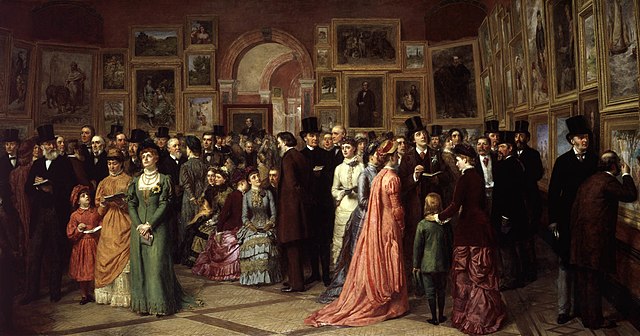
Frith, A Private View at the Royal Academy, 1881

What could be more pleasurable than the discovery of a new art gallery, especially if they have a café attached, so you can indulge yourself in a fantasy world of coffee, cakes and fine art, utterly shut off from the reality outside?

It wasn’t always like this. Outside of the UK, few galleries had cafes, and galleries have not until recently been pleasurable spaces to visit. 

Nor was I aware that they formed the subject of academic studies. I wasn’t aware of studies of art galleries, for example, the ideas behind their foundation, typically in Victorian times, until I came across a review of a book by Giles Waterfield, The People’s Galleries: art museums and exhibitions in Britain, 1800-1914 (2016). Sadly, this book is only available at crazy prices, so I have no chance of getting to a copy of it. But a TLS review, by Susan Owens, raises many points and makes it clear how the world in which these galleries were founded is very different to today’s world. And it’s not just the absence of a café.  

What factors led to the mass of local art galleries that we see today? The rise of an urban middle class, no doubt, the existence of learned societies perhaps less so, since there is no municipal art gallery in Spalding or Saffron Walden, despite those places having societies. The 1851 Great Exhibition was undoubtedly a spur, followed in 1857 by the Manchester Art Treasures Exhibition.  Waterfield himself states “It was on the foundations of such exhibitions – entrepreneurial, commercial, entertaining, accessible – that many provincial galleries were built.” 

How many of those adjectives apply to today’s public galleries? The provincial gallery has no hope of running a full commercial operation; it would not be possible to cover their running costs. I would guess that every public art gallery is subsidised from various sources. So if at all “entrepreneurial”, the gallery typically focuses on obtaining more funding wherever possible, rather than going all out to charge the visitor. 

Some initiatives are visible. The museum café, a bookshop and giftshop, and paid exhibitions are the most obvious initiatives. Oxford’s Ashmolean Museum had a vast extension built, partly to enable the museum to mount paid exhibitions – but whether those have generated substantial revenue is, I think, unlikely. One or two of their exhibitions might have made money, but that success has to compared to other exhibitions with only a tiny attendance, as far as I could see. London and Paris have a substantial gallery-going public who think nothing of paying hefty fees to see an exhibition if they think it is culturally important. Does a similar audience exist outside London?


But there are other, more fundamental differences from the art galleries founded in the 19th century and the gallery of today.  Susan Owen writes: 

When the Atkinson Art Gallery – a gift to Southport from the cotton manufacturer William Atkinson – opened in 1878, it had not a single work of art. Undeterred, the gallery sent out a circular to residents requesting loans for an inaugural exhibition, which turned out to be triumphantly successful, with over a thousand works lent to the gallery. 

Would the same thing happen today? I think not. The general public has abnegated any belief that they can arbitrate in the common taste. Nobody would dare offer the pictures from their living room to the Fitzwilliam; for the most part, that’s not the kind of thing the Fitzwilliam shows. Since 1878, we have lost (or at least we suppress) the feeling that we can participate in choosing the works that enter a gallery. 

Yet we may (sometimes) pay to participate in the cultural good of the collection. In the USA, payment is the norm, even if admission to the major collections is free for certain groups, such as army veterans. I didn’t see many veterans in the Boston Museum of Fine Art the day I was there. Denmark, the Aarhus Gallery, Aros, is a stunningly successful example of a paid gallery. It would appear the Danes have an insatiable appetite for a stylish art collection. When I last checked the figures, it had double the number of visitors of the Fitzwilliam per year, even if I am rather dubious about the claim on its website to be the most visited art museum in Scandinavia. Most of the publicly funded galleries in the UK are free; there would be an outcry if they introduced a charge. 

However, having free admission does not mean that the galleries provide equally for all classes. Early galleries tried for inclusiveness through extended opening hours into the evening, “to accommodate working men and women” (from the TLS review). Although the modern UK art galleries are largely free to access, I don’t see much sign of the working men and women. 

Is there a difference in what the galleries buy today with the Victorian heyday? Of course, the cash-strapped state of Britain today means that few galleries are buying art, tasteful or otherwise. And the 19th-century solution of art presented to the galleries by rich patrons seems non-existent. “More controversial works of art were being bought by Northern Industrialists … whose eye for detail and craftsmanship was amply rewarded by Pre-Raphaelite paintings.” Precious little sign of either the taste, or the purchasing, today. What industrialists like, and what galleries want to show, are a long way apart. Perhaps it is similar to the process of gentrification of inner cities: the museum remains, but no longer addressing the locality it serves. 

So is that it? Apart from the coffee shop, are the provincial galleries out of touch with their catchment area and their locality? Has culture drifted apart so much that what people want to see differs fundamentally to what the gallery wants to show? The present-day provincial art gallery inhabits a world of great uncertainty. Few museums seem to match the ability of the Whitworth Art Gallery, Manchester, both to genuinely engage with their local population, and also serve great coffee.


Tuesday, 16 March 2021

How to make a comedy fall flat


Judy Holliday, Broderick Crawford and William Holden in Born Yesterday (1950)

This film appeared on a BBC-curated list of the top 100 comedy films of all time. Given that recommendation, perhaps you would expect the film to be full of jokes from end to end. But the humour became rather subdued as the story proceeded, and by the end, few viewers would have called this a comedy. Unless you describe a monster hitting his girlfriend entertaining.

The plot is simple: this is a Pygmalion tale updated to the United States of the 1940s. A fabulously wealthy self-made man is visiting Washington to ensure greater market domination for his business. He is accompanied by his girlfriend, who is the focus of the story.  Like him, she lacks education and social breeding, but unlike him, she cannot even appear to be polite for a moment, and her lack of any experience in upper-class company is wonderfully entertaining as she tries to make conversation with a congressman and his wife. The plot is her partner’s attempt to educate her, a task he delegates to the wonderfully elegant and urbane journalist (William Holden) who has come to interview him.

So far, so good. The couple’s boorish behaviour (they shout at each other, and he mistreats the servants) is initially entertaining. The journalist, Paul Verrall, shows her the sights of Washington: he takes her to museums, to the Capitol, gives her books, and helps her read the daily paper. Suddenly she acquires an enormous dictionary, and starts to read all the papers placed in front of her, and starts to question her relationship with her abusive partner.

With an astonishing tour-de-force interpretation by Judy Holliday, the film could not fail to be funny. But, as mentioned above, the comedy starts to wear thin at this point. The film fails to maintain its light-hearted view of the couple. As Billy Dawn looks more closely at her partner, she doesn’t like what she sees. Nor do we respond very comfortably to a polished journalist trying to teach Billie how to live. She was inferior in her relationship to the bully, and she remains inferior to the journalist, who holds all the trump cards. This is not a relationship that will work, except in film (La-La) land.

The remaining 30 minutes or so are disastrous for the film. Unlike films such as Some Like It Hot, where the comic tone is maintained throughout, despite gangsters killing each other in full view, Born Yesterday feels the need to get sentimental about the American system, and to abandon the comedy to start telling the truth. Except that the American system is described so lovingly, and so falsely:

Paul: The whole history of the world is a story of a struggle between the selfish and the unselfish.

Billie: I can hear you.

Paul: All that's bad around us is bred by selfishness. Sometimes selfishness can even get to be a cause, an organized force, even a government. And then it's called fascism. Can you understand that?

Billie: Sort of.

In any case, the scenes set in the Capitol building have been changed forever by the sight earlier this year (2021) of marauding rioters occupying the Capitol. We don’t believe the lies (did anyone, ever?) told us about the US democratic system, and we feel uncomfortable that this comedy has suddenly turned very serious. So, while we can live with such lines as Billie, discovering herself: 

Billie: I don't know if it's good to find out so much so quick. 

We wince at the complacent, smug attitude that writes off corruption as “one bad apple”.

But, hell, in the end, I can’t deny there are lines in the script that are unforgettable: 

Harry Brock: Listen, cutie, don't get nervous just 'cause you read a book. You're as dumb as you ever were.

Harry is a monster, and the plot doesn't have to lose all the jokes to convince us that he is a monster. If only the plot had remained on this level, we would still be watching the film today. As it is, the tone of the last 20 minutes of the film is simply an embarrassment.


Tuesday, 2 March 2021

Does dumping really exist?


Photo by John Nyberg at FreePhoto.org


Dumping, in economics, means the selling of goods or produce cheaply in another market from the one in which it was produced.  It is a common claim by politicians that another country is dumping goods or materials in the home market. 

Dumping forms the subject of the recent, widely praised book, Trade Wars are Class Wars (Matthew Klein and Michael Pettis, Yale, 2020). It is used to explain much of the malaise of the modern world.

But does dumping actually happen? My feeble attempts to learn economics don’t seem to have said much about dumping – or perhaps I just wasn’t listening for that lesson. Let’s start by seeing what the orthodox theory is and then how it might be applied.

 Here’s what the Economist Dictionary of Economics says by way of definition:

 Selling something for less than the cost of producing it. this may be used by a dominant firm to attack rivals, a strategy known to antitrust authorities as predatory pricing. Participants in international trade are often accused of dumping by domestic firms charging more than rival imports. Countries can slap duties on cheap imports that they judge are being dumped in their markets. Often this amounts to thinly disguised protectionism. In practice, genuine predatory pricing is rare - certainly much rarer than anti-dumping actions - because it relies on the unlikely ability of a single producer to dominate a world market.  

So, according to the economist, you would need to dominate a world market to create predatory pricing.  

Here is the website Economics Classroom definition:

The practice of producers in one nation selling their output at a price lower than their costs of production in another nation. Considered a justification for protectionism by the World Trade Organization.

 I still don’t get it. Which country can afford to sell off its products for less than the cost of production?

 According to the book Trade Wars are Class Wars, dumping dates back to J A Hobson’s book Imperialism (1902). Hobson’s idea was that British mine owners made great efforts to sell manufactured goods in the colonies such as South Africa, while neglecting investment and living standards at home.

Now, I can understand the business practice of would-be monopolists such as Standard Oil (in the early 20th century) and Uber (in the 21st century). Both of them reduced prices in target markets to drive out competition, in the expectation that they could raise prices subsequently. But could any Chinese company (say) afford to flood the European market with such cheap steel that all the European producers went out of business? Or, perhaps more likely, if the European producers are not as cost-effective as Asian companies, it would be economically better for them to cease producing steel, as long as the resulting market left competition available – and steel is produced in Korea, China, Australia, and many other countries.

In short, I am not convinced by the dumping argument as practised by a nation state, although I can believe it if practised by a corporation.